In Focus This Week
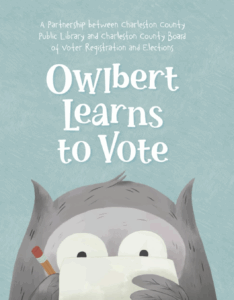
Owlbert Learns To Vote
Charleston County, SC creates award-winning children’s book
By M. Mindy Moretti
electionline.org
As with so many good things, it started with a sticker.
 Following the enthusiastic response to the launch of “Future Voter” stickers in 2022, the Charleston County, South Carolina Board of Voter Registration and Elections (BVRE) recognized the desire among young families to learn how to teach their children about democracy in a relatable and accessible way.
But even before then, BVRE Executive Director Isaac Cramer had been dreaming, and planning.
“In 2021, I shared with the Library Director that I hoped to one day create a children’s book about voting. I knew the library team lived and breathed children’s content, and they would be the right experts to help bring it to life,” Cramer explained. “I had the idea, the overall plot, and the goals for what I wanted the story to teach. From there, the library team asked thoughtful questions that helped shape the direction of the book.”
Enter the award-winning Owlbert Learns to Vote, a story featuring the library’s mascot, Owlbert.
In the story, Owlbert and his classmates face a community proposal that would impact their local field—a decision about whether to construct a playground where they currently play soccer. Despite differences of opinion, their teacher emphasizes that cooperation and respect are essential for a thriving community and that disagreements don’t have to divide people permanently.
Owlbert won a 2024 U.S. Election Assistance “Clearie” Award for Distinguished Voter Education and Communications Initiatives and was the recipient of the 2025 Freedom Award for Professional Practice Papers from the Election Center.
The book, which self-published in 2024, was written and illustrated by Charleston County Public Library staff.
“I certainly could have attempted to write it myself, but it became clear early on that their experience with children’s storytelling would make the book stronger. We explored different authors, but ultimately decided the library team would take the lead on drafting,” Cramer explained. “Those drafts sparked lots of discussions, edits, and rewrites. We met frequently, collaborated closely, and refined the story together until it became the final version we have today.”

Charleston County Board of Voter Registration and Elections Executive Director Isaac Cramer and Charleston County Public Library Executive Director Angela Craig with the real life Owlbert.
The book has been an overwhelming success, generating significant interest from parents, teachers, and election officials both locally and internationally. Requests for copies have come from across the United States, including from schools in Connecticut and Florida.
In Charleston County, BVRE partnered with Charleston County School District (CCSD) to make the book available in dozens of school libraries. As part of this program, election officials visit schools to conduct mock elections, teach lessons about the electoral process, and engage directly with students’ questions.
“I always believed that a story centered on a universal theme could resonate beyond Charleston County,” Cramer said. “In our very first meetings, I emphasized that we wanted the book to feel applicable anywhere in the country—not Charleston-specific. I imagined people would connect with the message. But after NPR picked it up, I was genuinely surprised (in the best way) by how quickly requests started coming in from outside South Carolina.”
The book is now available through Amazon and ships in about two days with Prime so just in time for some last-minute holiday giving! And while it was originally self-published, making it available for broader purchase was a challenge Cramer said.
“Neither the library nor our office had the capacity to manage sales and shipping on top of our day-to-day responsibilities,” Cramer said. “Using Amazon Kindle Direct Publishing ended up being the perfect solution—Amazon prints and ships the book for us. Our goal wasn’t to make a profit; it was to make sure this story could reach readers across the country without creating administrative burdens for our teams.”
The proceeds benefit both the library and the BVRE. Those funds go right back into supporting additional print runs so they can keep the book accessible.
And while Owlbert has learned to vote, he’s not done with his lessons in civics and democracy.
“We absolutely plan to continue the series,” Cramer said. “Stay tuned, the next adventure is already in the works!”
electionline Holiday Schedule
 During the upcoming holiday season, electionline–both the Daily and the Weekly–will be making some temporary changes to their schedules. Here’s what we’ve got for now!
Electionline Daily News: The Daily News will NOT publish December 24-26, December 31 or January 1, 2026. From December 17-January 2, 2026 the Daily will post by 10am Eastern.
ElectionlineWeekly: The Weekly will not publish on December 25 or January 1, 2026. It will however publish on Tuesday, December 30 and feature our always much anticipated In & Out List.
electionline Merch
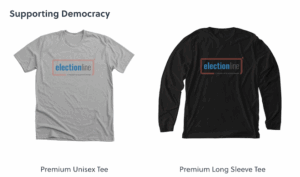 You’ve asked for it, well now you’ve got it! Just in time for all of your holiday gift-giving. We’ve opened up an electionline merch store using Bonfire. Currently we’re offering a couple of different t-shirts, a long-sleeve t-shirt and a hoodie.
Election News This Week
 List Maintenance: Ohio Secretary of State Frank LaRose announced the creation of a new, multi-state election integrity network known as EleXa, a national coalition formed to exchange election records for use in identifying illegal voting activity. “Election integrity will always be our top priority, and that starts with our duty under the law to maintain accurate voter rolls,” said Secretary LaRose. “These data-sharing agreements allow Ohio to work with our colleagues in other states to identify people who try to vote illegally, often by having more than one active voter registration and then casting multiple ballots in the same election.” The name of the project, EleXa, is a nod to “election administration,” with a symbolic ‘X’ representing the removal of illegal or ineligible voters identified through formal cross-state election data sharing agreements. So far, Ohio has signed voter list sharing agreements with secretaries of state in Alabama, Arkansas, Florida, Indiana, Iowa, Kentucky, Louisiana, Texas, Virginia, and West Virginia, and Pennsylvania is finalizing an agreement. The agreements will enable Ohio to maintain more accurate voter rolls by removing out-of-state voters, and better prevent and detect multi-state voting.
 Election Do-Over: This week, the North Carolina State Board of Elections ordered new elections in the races for Morehead City mayor and for Harrellsville mayor and town council in Hertford County. In the Morehead City mayor’s race, challenger Lee Stiles leads incumbent Jerry Jones by one vote. One of Jones’ lawyers, Christopher Stock, told the board that two men who planned to vote for the incumbent were improperly turned away when they should have been offered provisional ballots. “The fail-safe process we have in the state was not used,” he said. Another of Jones’ lawyers, Phil Thomas, requested the board permit those two voters to cast ballots now. But board members said the law won’t allow the two voters to cast ballots after the fact. Ordering new elections is rare, Board member Stacy “Four” Eggers IV said. And the Morehead City mayor’s race is proof that every vote matters. “A single vote absolutely is important.” In the Hertford County case, no one signed up to run for Harrellsville mayor, but voters could write in candidate names. Three people signed up to run for five seats on the Harrellsville town council. Voters could also write in names for those seats. The Hertford County Board of Elections didn’t certify the Harrellsville results because of “irregularities affecting the integrity and accuracy of the election.” The State Board voted to rerun the entire election in March. “Hopefully, the precinct workers will know how to properly process voters and give them correct ballots,” Eggers said.
 Cookie News: ‘Tis the season for cookies and NPR Weekend Edition Sunday Host Ayesha Roscoe recently took a look at how Suffragists often raised money for their activities with bake sales and by compiling cookbooks to sell. “We wanted to get a sense of what the suffrage bake sales looked and tasted like, but found that the recipes were hard to recreate. In the recipes printed in the Woman’s Exponent, a suffragist newspaper in Salt Lake City, the flour and butter were measured by the pound, not the cup. The recipes call for ingredients that are hard to come by today. They also don’t specify cooking temperatures or time,” Roscoe reported. She and her team attempted to make at least two of the cookies featured in the paper and The Suffrage Cook Book. “[W]e tried baking some kiss cakes from 1885. The result didn’t have the pizazz of cookies with multicolored sprinkles and frosting, and they weren’t nearly as sweet as the cookies we eat today. But they were cute,” she reported.
 Sticker News: This year, for the first time ever, Merced County, California Elections held a contest to design custom “I Voted Early” stickers that are truly unique to the region. The idea was to involve young Merced County students — 1st through 5th grade — to take part in the contest as a way to get them
  involved in today’s election process and introduce them to our democratic system of government. “I am happy to report that we received hundreds of submissions from schoolkids across the county,” said Mel Levey, the Registrar of Voters. “In many cases, teachers would bring in submissions for their entire class.” The sticker designs were reviewed by the Elections Department to ensure that they met the qualifications. They even had California Secretary of State, Dr. Shirley Weber, review them during a recent visit to Merced. “She was greatly impressed by the creativity of Merced County’s children and excited to see younger generations learning about elections,” Levey said. In mid-November, a decision panel was convened to choose the contest winners. In keeping with the theme of educating the students of Merced County about elections, Amy Taylor, the Merced County librarian and Dr. Susan Walsh, the president of the League of Women Voters of Merced County, joined Levey and Regan McGuire, the assistant registrar of voters, to determine the winning designs.
Personnel News: Columbus Township, Michigan Clerk Jeff Anderson recently announced his resignation. Hannah White has joined the Sampson County, North Carolina board of elections. Lee County, Florida Commissioner Cecil Pendergrass has applied to become the next supervisor of elections. Scott O. Konopasek has been appointed to the Hanover County, Virginia board of elections. Logan County, Colorado Clerk & Recorder Pamela Bacon has announced her plans to seek re-election. Eve Furse announced Dec. 17 she’ll retire at the end of her term in 2026 after about five years as Summit County, Utah clerk.
 In Memoriam: Donald Lavonne Hersey, former Putnam County, Florida supervisor of elections, has died. He was 87. Hersey served as Putnam County’s supervisor of elections from 1977 until his retirement in 2005. His nearly three decades in office spanned sweeping changes in election administration, voting technology, and public expectations for transparency and fairness. “He truly was a public servant, always giving, always doing for others and never asking for anything in return,” said his daughter, Donna Hersey Feibelman. “That’s who he was his entire life.” That reputation followed Hersey into public service, where colleagues said he earned respect for his fairness and nonpartisan approach to election administration. “You serve all the candidates and all the voters,” said Charles Overturf III, the current supervisor of elections. “Don understood that. If he did something for one person, he’d do it the same way for the next.” Hersey was first elected in 1976 and took office the following year after the retirement of longtime elections official Vivian Rivers, who publicly endorsed him. Bates said Hersey never sought power for its own sake and was encouraged to run by residents who already trusted him. “People pushed him to run because they knew the kind of man he was,” Bates said. “He didn’t change when he got elected. He was the same Don Hersey before and after.” Susan McCool, who worked alongside Hersey beginning in 1977 and later succeeded him as supervisor of elections, said his leadership helped establish the foundation of integrity that continues to guide the office today. “He wanted to make sure elections were done correctly, and he studied constantly to do that,” McCool said. “He truly enjoyed the work, and when you enjoy something that much, you strive to do it right.”
New Research & Resources
 Accessibility: Disabled Americans have long faced barriers to voting, and recently enacted anti-voting state laws have increased these barriers. A total of 79 restrictive voting laws were passed between 2021 and 2024, including constraints on who is allowed to assist with completing and returning a disabled person’s ballot in both Texas and Georgia in 2021. President Donald Trump is also considering ways to eliminate mail-in voting, which would add to disabled voters’ current voting barriers that already include physically inaccessible polling places and heightened health risks. At the same time, some members of the disability community have already had their voting rights stripped entirely due to state guardianship laws. In many states, people under guardianship are automatically barred from voting or may lose their rights at the discretion of a judge or guardian. Guardianship can have sweeping consequences for the civil rights of people with disabilities, including the loss of autonomy, privacy, and political participation. As part of the Center for American Progress’ continued work on disabled people’s access to democracy, this report analyzes how guardianships can significantly restrict the voting rights of people with disabilities. It explores the legal processes by which guardianships are initiated and how these processes can result in the loss of voting rights; the lack of comprehensive data on guardianship; and the inconsistent and inequitable ways voting restrictions are applied across states. The report documents how state-level policies curtail voting access and analyzes recent legislative activity on the voting rights of people under guardianship. It also offers policy recommendations around ensuring voting rights are preserved, expanding the use of supported decision-making (SDM), and strengthening oversight of guardianship proceedings. Ultimately, policymakers should work to eliminate the use of guardianships and move to SDM agreements.
Election Security: In a new paper – Bridging Divides: Recultivating Election Security and Trust – from the Institute for Responsive Government, former election officials Kathy Boockvar (D-PA) and Matt Crane (R-CO) discuss the challenges that have emerged over the past five years in the elections space — polarization accelerating into hostility; false narratives and propaganda sharpening every divide; and escalating attacks on the very bedrock of our electoral system.
 Vote by Mail: The Rose Institute of State and Local Government at Claremont McKenna College has released a report analyzing how California’s transition to vote-by-mail elections has contributed to the state’s slow vote counts. The report, titled Democracy Delayed: The Operational and Partisan Impacts of California’s Election Administration System, shows how this transition has affected both ballot-processing times and partisan outcomes. This report explores the effects of the transition at the county level through analysis of the California Secretary of State’s Unprocessed Ballot Reports. The results indicate that, following initial delays, counties generally have become more efficient the longer they use the new system, suggesting that institutional learning plays a key role in improving ballot-processing speed. Notably, these findings indicate that slower processing is not inherent to vote-by-mail elections, and that California’s overall efficiency may improve in future cycles as counties continue refining their procedures. Beyond administrative challenges, the report identifies small but meaningful partisan effects, especially in close contests. Across four recent election cycles, eight US House races experienced a change in the leading candidate as ballots continued to be counted. In most of these cases, an initial Republican lead flipped to a Democratic victory. This can be attributed to a measurable advantage among late-tabulated votes. Democratic candidates in these key races maintained a consistent advantage in ballots tabulated 14 or even 21 days after the election was held.
 Local Montana Elections: In a final report on elections in Carbon, Cascade, Lake, Lewis and Clark and Missoula counties, Montana Election Observation Initiative said local officials followed state law, maintained strong chain-of-custody procedures and gave observers access from pre-election testing through the post-election canvass. Both hand counts in smaller counties and machine tabulation in larger ones were conducted without technical issues, with unofficial results posted in offices and online within hours of polls closing. The report said Montana’s vote-by-mail system, anchored in signature verification and paper ballots, continued to meet key security and access standards. Pre-election logic and accuracy tests for tabulators were completed on time and in public, and ballots were consistently tracked, batched and securely stored between processing sessions. Observers raised sharper concerns about House Bill 719, which for the first time required voters to provide a year of birth on absentee materials. Across the observed counties, between roughly 1 and 4% of ballots needed curing because of missing or deficient information, and only 38 to 58%of those voters ultimately corrected their ballots where full data were available. MTEOI found no indication that the additional check produced measurable security benefits. None of the five counties reported referring possible absentee ballot fraud to law enforcement in 2025, matching recent election cycles and prompting the group to question whether the rule adds value beyond existing signature verification. The initiative also criticized uneven voter education around the change, noting that some counties relied mainly on social media while others used ballot inserts, new envelope designs or standalone mailers. The nonprofit encouraged the Secretary of State to lead coordinated, statewide messaging ahead of anticipated higher turnout in 2026.
 Ranked Choice Voting: In June 2025, New York City voters used ranked choice voting (RCV) in their primary elections for the third time. Voters had the opportunity to rank candidates for office in 38 contests across the city, including the competitive Democratic mayoral primary. National media outlets and leaders took note of how RCV shaped the mayoral race. In this report, we address whether RCV delivered its intended benefits, including delivering majority winners without a costly runoff election, better reflecting voter desires, and making campaigns more civil. FairVote used both qualitative data — largely press and campaign materials — and quantitative ballot and survey data to draft this report.
Findings include:
- Ranked choice voting delivered majority winners without costly runoffs, with additional indicators capturing the winners’ high level of voter support. An average of 74% of voters ranked winning candidates in their top three choices. The primaries saw the highest turnout since 1989.
- Ranked choice voting resulted in more representative outcomes that better reflected the will of voters. In contests that went to an RCV count, a total of 243,808 voters ranked a non-frontrunner first but had their vote count for one of the finalist candidates because of RCV — capturing exactly how RCV allows voters to express their true preferences without fear of wasting their vote. This included 159,619 voters in the Democratic mayoral primary, where 95% of voters expressed a preference between the top two candidates.
- Voters embraced ranking, with 78% ranking at least two candidates in the Democratic mayoral primary, and 76% saying they would like to keep RCV or expand it to more elections.
- Ranked choice voting improved campaign civility and collaboration, with several candidates “cross-endorsing” one another and local organizations providing ranked endorsements. There is also compelling quantitative evidence that voters followed this guidance at the ballot box, which we discuss in detail later in the report.
Ballot Measures, Legislation & Rulemaking
 Democracy Round-Up: Tracking more than 50 laws and policies related to voting and elections, the Democracy Maps reveal the incredible differences in access to voting and election independence across the country. MAP updates the Democracy Maps in real time as legislatures across the country pass laws impacting voting, elections, and our democracy. As the year comes to a close — with only a handful of states remaining in legislative session as of this writing — MAP is looking ahead to 2026 and offering an overview of the major trends from election and voting related legislation in 2025. There were thousands of election- and voting-related bills introduced across the country in 2025 and although we’ve seen an alarming number of efforts to further restrict access for voters and protections for democracy, we intend to highlight the very real wins around the country by activists and advocates committed to safeguarding access to the ballot.
 Ballotpedia Year in Review: Ballotpedia’s 2025 annual review of election-related state legislative activity highlights another significant year of voting and election process policymaking across the country. Ballotpedia has tracked 4,969 election-related bills and resolutions introduced in state legislatures in 2025—surpassing the totals for 2022, 2023, and 2024. More than 600 new laws were enacted in 2025. Visit the Ballotpedia YouTube page to watch an overview of the State of Election Administration Legislation 2025 Year-End Report
 District of Columbia: D.C. is moving forward with ranked-choice voting in next year’s June primary election, after an attempt by a group of D.C. lawmakers to delay the new voting method failed on December 16. D.C. Council members Anita Bonds (D-At Large) and Wendell Felder (D-Ward 7) pushed an emergency measure that sought to delay ranked-choice voting until 2027, expressing concerns that the D.C. Board of Elections did not have enough time or a firm enough plan to successfully implement the new voting method by June. “It is clear that January to June 2026 is an unacceptable calendar. It simply is not enough time to execute a new large-scale process that will have an impact on thousands of our residents,” Bonds said during the debate. But the measure failed by a vote of 8-5, as a majority of lawmakers saw the attempt as delaying the will of voters who passed a ballot initiative last year and, with an election cycle already underway, inappropriately halting a voting method that candidates and voters were expecting to use. Council member Charles Allen (D-Ward 6) said lawmakers needed to stop the “confusing messaging we keep sending out of, ‘will we, won’t we’” and implement ranked-choice voting because it is already the law and it is moving forward.
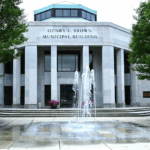 Coldwater, Michigan: The City of Coldwater is looking to change the years municipal elections are held. The Coldwater City Council approved a request from City Clerk Shauna Chavez Monday night to pass a resolution which changes the city election cycle from odd years to even years. Cities around Michigan can make such a change without a charter amendment under a state law that was passed in 2012. It will be up to the Michigan Secretary of State’s office to approve the change for the City of Coldwater which would take effect on December 31. An ordinance was also introduced which would amend the city’s Codified Ordinances covering City Election cycles. Final action is scheduled for the Council’s meeting on January 12, 2026. Chavez said in accordance with Michigan Election Law, the four year terms for the current councilmembers would be extended by one year.
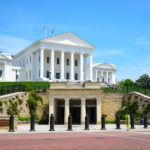 Virginia: State Sen. Schuyler VanValkenburg (D–Henrico) has filed new legislation that would return Virginia to the Electronic Registration Information Center. Virginia was one of ERIC’s founding members in 2012 under Republican Gov. Bob McDonnell. The members of ERIC — 25 states and the District of Columbia — share registration data and other reports with each other to improve the accuracy of their voter rolls. Youngkin’s administration withdrew from ERIC in May 2023, citing increased costs and “concerns regarding stewardship, maintenance, privacy, and confidentiality of voter information.” Virginia has deals with Tennessee, Kentucky, Maryland, West Virginia, Alabama, Mississippi, Ohio, Texas and the District of Columbia to share voter data. VanValkenburg said he thinks the individual agreements can’t replicate ERIC, arguing it’s the best organization for voter list maintenance. He also pointed to issues like the accidental purge in 2023, which he said could have been caused partially by leaving ERIC but also “mistakes or incompetence.” Senate Bill 57, set to be heard during the 2026 General Assembly session, would also require the commissioners to “take any steps necessary to preserve the Commonwealth’s status as a member in good standing of ERIC.” The goal of the legislation is to take it out of the executive branch’s hands, he said, “to make sure that we can’t have a governor just unilaterally pull us out.”
Legal Updates
 Colorado: The Trump administration wants driver’s license numbers and the last four digits of social security numbers for all of Colorado’s registered voters, and on December 11, they sued the Colorado Secretary of State to get it. In the eight-page complaint filed in U.S. District Court for Colorado, the Department of Justice cited a 1962 Civil Rights-era precedent saying they were owed all “records and papers which come into their possession relating to any application, registration … requisite to voting in such election.” The Justice Department at that time was suing to prevent southern states from systematically excluding Black residents from voter rolls. It’s less clear what the Trump administration is trying to accomplish with last week’s suit. The lawsuit is a culmination of months of back and forth between Democratic Secretary of State Jena Griswold and the DOJ regarding sensitive voter information from Colorado residents. Bondi’s lawyers said in the recent filing that they are trying to enforce various election statutes, including the Civil Rights Act, the National Voter Registration Act and the Help America Vote Act. In conducting these probes, they need the state to “be in compliance with federal election law.”
President Donald Trump signed a formal pardon for Tina Peters, according to Peter Ticktin, her Florida-based attorney, who shared the pardon document with Colorado Newsline. The document, which appears to be dated Dec. 5, says it grants “a full and unconditional pardon” for “those offenses she has or may have committed or taken part in related to election integrity and security during the period January 1, 2020 through December 31, 2021.” The pardon applies to Peters’ conviction on state charges, Ticktin said. The charges related to Peters’ role in a 2021 security breach when she was the Mesa County clerk. Presidential pardons have universally been understood to apply only to federal crimes, not state crimes. Reports about Trump’s claim to have pardoned Peters, announced on social media, characterized it as empty or “symbolic.” “Trump’s pardon has no legal impact on her state conviction and incarceration,” according to CNN. But Ticktin says the pardon is the tool he needs to compel Colorado to free Peters. “She didn’t commit any federal offenses,” Ticktin said in an interview with Newsline. “The only thing that she could be pardoned on are state offenses, because that’s all that are out there.”
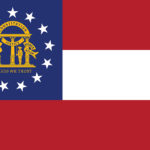 Georgia: The U.S. Department of Justice has filed a lawsuit against Fulton County for refusing to turn over voter records from the 2020 election, escalating an ongoing legal campaign aimed at forcing state and local officials to disclose sensitive voter roll information to the federal government. The lawsuit, filed in a federal district court in Atlanta, demanded that Fulton County turn over “all used and void ballots, stubs of all ballots, signature envelopes, and corresponding envelope digital files,” from the 2020 election. It also accuses Fulton County Clerk Ché Alexander of violating federal laws for refusing to relinquish the records. In a statement, Assistant Attorney General Harmeet K. Dhillon said the records were needed to protect U.S. citizens from “vote dilution.” Trump has long claimed — without evidence — that the 2020 election was stolen in Georgia and other swing states, blaming his loss on unfounded accusations of rampant voting fraud, even though two recounts affirmed former President Joe Biden’s victory in Georgia. In an interview with POLITICO published earlier this week, Trump claimed that in the next few months, evidence would emerge to prove that 2020 was “a rigged election.” Black Voters Matter and local affiliates of the Communication Workers of America labor union are asking to intervene in the U.S. Justice Department’s lawsuit seeking Fulton County’s 2020 ballots. The groups filed a motion this week to join the lawsuit, arguing the Justice Department should not get the ballots and other election records because they are under seal and “no federal law justifies DOJ’s far-reaching demand.” Lawyers from the organizations claim the Justice Department is attempting “to fan the flames of conspiracy and sow doubt about the legitimacy of the 2020 election.” The Justice Department sued the Fulton County Clerk of Superior Court Ché Alexander last week seeking the ballots and other election materials — a significant escalation in the continuing battle over Georgia’s 2020 election results. In court documents, the lawyers said the department is engaged in a “vengeful” effort and allowing them access to the election materials would undermine their clients’ efforts to mobilize voters. If voters knew the department would “rummage through their ballots” and other documents to support a conspiracy, it would deter people from voting in future elections, the groups allege. The groups said they seek to intervene to protect the voting rights and privacy of their constituents.
 Hawai’i: The U.S. Department of Justice added Hawaiʻi to the list of 17 other states it has hauled into court as part of the Trump administration’s effort to gather sensitive personal information on all registered voters across the nation. U.S. Assistant Attorney General Harmeet Dhillon wrote to the Hawaiʻi Election Office on Sept. 8 to request the voter registration information, including drivers license numbers and partial social security numbers. That request has been made to at least 40 states, according to the Brennan Center for Justice. Chief Elections Officer Scott Nago refused, and on December 11 the DOJ filed suit in Honolulu federal court. The lawsuit seeks to compel Nago to provide the voter registration information under the Civil Rights Act of 1960, which allows the attorney general to demand the production, inspection, and analysis of statewide voter registration lists. The DOJ demand seeks the full name, date of birth and home address of each Hawaiʻi voter along with either the driver’s license number, the last four digits of the voter’s social security number or a unique identifier number assigned to each voter under the Help America Vote Act of 2002. Nago declined to discuss the DOJ lawsuit, saying his office does not comment on pending litigation. Toni Schwartz, public information officer for the state Attorney General’s office, issued a written statement Friday saying that “we will vigorously defend privacy rights of Hawaiʻi’s voters and our lawful election practices against the federal administration’s continued, nationwide overreach.”
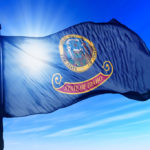 Idaho: A 2025 candidate for Ketchum City Council filed a lawsuit challenging the Nov. 4 elections, over how candidate names were rotated on ballots. Candidate Perry Boyle is asking the court to annul the certified results and order a new election, according to a news release from the Blaine County Clerk. Boyle’s argument centers on the rotation of his name on ballots. Officials said Ketchum has two precincts, and candidates were listed alphabetically with rotation by precinct, consistent with the Secretary of State Phil McGrane’s regulations. In one precinct, Boyle’s name appeared first on the ballot. In the other precinct, the candidate list was rotated by one position, placing his name last. The Blaine County Clerk said the county followed state law regarding ballot name rotation. “Our responsibility as election officials is straightforward: to administer elections in strict compliance with Idaho law and the directives of the Secretary of State,” officials said. “This election used the same state- and federally-certified voting systems that counties use statewide.” Before Boyle’s lawsuit, the clerk said the Idaho Secretary of State’s office publicly confirmed that Blaine County complied with the law.
 Maine: Maine asked the district court to throw out the lawsuit from President Donald Trump’s Department of Justice over the state refusing to turn over sensitive voter data. The motion to dismiss, filed in the U.S. District Court of Maine by Attorney General Aaron Frey on Dec. 12 on behalf of the state, argues that the lawsuit should be discharged in its entirety because the DOJ failed to support a valid legal case as to why it is justified to such information, and that its information requests violate federal privacy law. Maine Secretary of State Shenna Bellows, a Democrat who is running for governor in 2026, has twice rejected these requests, which have demanded Maine’s full voter registration list — including all fields, such as driver’s license numbers, partial social security numbers and full dates of birth — along with names of officials who handle the list’s maintenance, the number of ineligible voters the state identified due to noncitizenship and voter registration applications from specific time periods, among other information. In September, the DOJ sued Maine and Oregon for not turning over the information and has since launched lawsuits against roughly half a dozen other states.
 Missouri: Cole County Judge Christopher Limbaugh said December 12 that he is pausing a case over whether Secretary of State Denny Hoskins can throw out thousands of signatures for a Missouri redistricting referendum, pointing out that it may be moot if the referendum qualifies for the November 2026 ballot. People Not Politicians sued Hoskins after he said he would not count signatures collected before the middle of October. That group then turned in more than 300,000 signatures, likely more than enough to make the ballot even without any gathered before mid-October. “Currently, to the court’s knowledge, no signatures have been officially accepted or rejected. Conceivably, this could be enough signatures to place the referendum on the ballot thereby mooting the issues presented in the case at bar,” Limbaugh wrote. “Therefore, the court will hold this case in abeyance until the requisite number of signatures have been certified or up until enough signatures have been rejected so as to prevent plaintiffs’ referendum from appearing on the ballot. It is further ordered that Secretary Hoskins preserve all signatures filed with his office, whether those signatures are accepted or rejected, until further order by this court.” Hoskins told St. Louis Public Radio this week he is not disposing of the pre-Oct. 14 signatures.
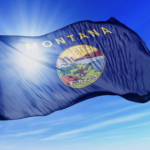 Montana: The Chippewa Cree Indians of the Rocky Boy’s Reservation will have the chance to elect a representative of their choice to the Chouteau County Board of Commissioners following a settlement in a Voting Rights Act lawsuit. In the lawsuit, the tribe and two Native American voters alleged Chouteau County’s at-large voting system unlawfully diluted the voting strength of Native voters and denied them representation on the county commission for more than a decade. A settlement approved this week by the U.S. District Court of Montana ensures the tribal nation’s reservation will be part of the county’s District 1, which will elect a representative to the Board of County Commissioners through a single-member district election, the ACLU of Montana said Wednesday in a news release. In a statement from the ACLU, Chippewa Cree Tribe Chairman Harlan Gopher Baker praised Chouteau County for doing the right thing in giving the tribe a chance to elect a representative to the board. “It has been more than a decade since we have had a Native voice in county politics,” Gopher Baker said. “We look forward to being a part of this conversation.”
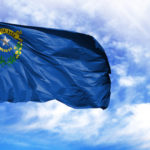 Nevada: The Justice Department’s Civil Rights Division filed a federal lawsuit against Nevada on December 12, saying the state failed to provide its statewide voter registration list when requested. The action is part of a broader federal effort to enforce election-record laws. The DOJ argues that Congress granted the Attorney General authority to enforce the National Voter Registration Act and the Help America Vote Act, which require states to maintain accurate voter registration lists. Federal officials also cite the Civil Rights Act of 1960, which allows the government to request, inspect, and review statewide voter registration records. Nevada officials, however, say the federal government is seeking sensitive voter information without explaining how it will be protected. In a statement, Nevada Secretary of State Francisco Aguilar said the DOJ is requesting data that includes driver’s license and Social Security numbers and has not provided adequate details about data security. “The Department of Justice is making sweeping demands of states to hand over private voter data. Despite our simple requests for information on how they’re going to keep this data secure, they’ve given us no clear answers,” Aguilar said. “It’s my duty to follow Nevada law and protect the best interests of Nevadans, which includes protecting their sensitive information and access to the ballot.” Aguilar also said the federal government is exerting pressure on states ahead of the 2026 election cycle. The ACLU said its national organization and Nevada chapter filed a motion to intervene in the department’s lawsuit against the state. In its motion, the ACLU argues that its members have a right to privacy and that its organizational mission could be harmed if the federal government obtains sensitive voter data. “If our motion is granted, we remain poised to defend the privacy rights of Nevadans in the face of unauthorized, improper demands by a federal government insistent on expanding its own power while undermining the privacy rights of ordinary Americans,” ACLU of Nevada Executive Director Athar Haseebullah said in a statement.
 New Hampshire: Rockingham Superior Court Judge David Ruoff dismissed a lawsuit against new, stricter identification requirements for New Hampshire absentee voters, ruling that the law is constitutional and treats absentee voters with the same scrutiny as in-person voters. The lawsuit, brought by three visually impaired residents against Secretary of State Dave Scanlan, sought to strike down the law created by Senate Bill 287. That law, signed by Gov. Kelly Ayotte in August, requires absentee voters to provide identification each time they vote. Under the new law, absentee voters can do that by providing a photocopy of the ID with their mail-in ballot, getting a notary to sign the ballot, or going in person to their town or city clerk and presenting their ID. At issue in the case was whether the new ID requirements impose “severe restrictions” on voters or nondiscriminatory and reasonable ones. In a nine-page opinion, Ruoff ruled that the restrictions are not severe. “Burdens are generally deemed severe when they outright exclude voters from the process,” Ruoff wrote. “Here, the identification requirements impose ordinary burdens on all absentee voters, and the possibility that it may cause additional burden on a subset of absentee voters does not render the entire statute unconstitutional.” Ruoff noted that the statute provides multiple options for absentee voters who might lack the means to take one particular approach. And he reasoned that voting always includes some effort, and that before the new law, absentee voters “were already required to mail or provide their application to the secretary of state or town or city clerk.”
Ten days after lawyers for the Trump administration filed a brief looking to block a group of New Hampshire residents from joining their voter registration lawsuit, the government now says it no longer is taking a position on the matter. Longtime personal privacy advocate Neal Kurk joined Christopher Cole, a Portsmouth attorney, former Democratic state representative Bob Perry and Louise Spencer, co-founder of the liberal advocacy group Kent Street Coalition, in filing a motion seeking intervenor status — which would allow them to file their own motions against the lawsuit. In a brief filed Dec. 5 in the U.S. District Court of New Hampshire, Department of Justice attorneys argued the four residents don’t meet the legal requirements necessary to be added as intervenors. But in a new brief filed December 15, attorneys for the Trump administration say while the United States “initially opposed the Motion to Intervene and filed its response, the United States notifies the Court that it now takes no position on the Proposed Intervenors’ Motion to Intervene.”
 Oklahoma: The Oklahoma Supreme Court blocked controversial new social studies standards from going into effect, ruling that the guidelines—which reference discredited claims of widespread voter fraud in the 2020 election, and include dozens of references to Christianity and the Bible—were approved without the legally required public notice. After State Superintendent Ryan Walters stepped down, new State Superintendent Lindel Fields rolled back some of those standards and now with this week’s decision from the state Supreme Court, Oklahoma must go back to the drawing board on the social studies standards, too. Teachers will continue to use the 2019 social studies standards, pending a new revision process. Even before the court’s decision, Fields had announced tentative plans to make rewrites to the 2025 standards, citing a need to evaluate whether additions were “germane to what kids need to learn,” the Oklahoma Voice reported in October.
 Tennessee: Memphis-Shelby County Schools board members are suing the Shelby County Election Commission over 2026 election changes that would cut short more than half of the board’s terms. The lawsuit argues that abridging board members’ terms is unconstitutional and against state code. It also calls the changes “legislative punishment masquerading as election reform.” MSCS board members are also seeking a preliminary injunction to stop the commission from holding the reset election, which is set to kick off with partisan primaries in May. In an emailed statement, Administrator of Elections Linda Phillips said she is “aware of and disappointed” that the school board is suing the Shelby County Election Commission. “The Shelby County Election Commission works to ensure elections are properly administered, but does not decide which elections are placed on the ballot,” Phillips said.
 Wyoming: An attorney for Weston County Clerk Becky Hadlock wants a judge to toss the criminal case over his client’s failure to appear at a legislative committee meeting where she had been subpoenaed to testify, new court filings show. “Through this prosecution, the State of Wyoming seeks to enforce a legislative subpoena issued to Weston County Clerk Becky Hadlock,” the motion filed this week states. “But that subpoena was void from the start so this prosecution must fail as a matter of law.” During an appearance in Natrona County Circuit Court, Hadlock pleaded not guilty in November to a misdemeanor charge of defying a legislative subpoena. Months earlier, the Legislature’s Management Audit Committee subpoenaed the clerk to appear at its September meeting in Casper. At the time, the panel was investigating Hadlock for her role in a miscount and subsequent audit in the November 2024 election. The miscount stemmed from an error in her office and led to a dramatic undercount in the number of votes for a state lawmaker who was running unopposed. But such an investigation is not the purview of the Management Audit Committee, argues Ryan Semerad, Hadlock’s defense attorney. “State law assigns all investigations into suspected violations of Wyoming’s Election Code to the Executive Department through the Wyoming Attorney General, the local county prosecuting attorney, or the county sheriff,” Semerad’s motion states.
Opinions This Week
National Opinions: Election legislation | Democracy | Vote by mail | Ex-felon voting rights
Alaska: Citizenship ballot measure
Colorado: Tina Peters, II
Maine: Election reform
Maryland: Maryland Voting Rights Act
Massachusetts: DOJ voter data request
Minnesota: Ranked choice voting
North Carolina: Polling places
Ohio: DOJ voter data request
South Carolina: Nursing home voters
Texas: Noncitizens
Upcoming Events
JEOLC 2026: The Election Center will host the 2026 JEOLC conference at the Ritz Carlton in Pentagon City, Virginia in early January 2026. One CERA renewal class will be offered. When: January 7-9. Where: Pentagon City, Virginia
Southern Political Science Association 2026 Conference: Experience Southern’s Hospitality at the 2026 SPSA Conference in New Orleans! The 2026 SPSA Preliminary Program is available HERE. Updates will be made periodically to the program, so please refer to this page for the most updated version available. When: January 14-17. Where: New Orleans
iGO Midwinter Conference: The International Association of Government Officials will hold its Midwinter Conference in Albuquerque, New Mexico from January 19-23, 2026. Please visit the iGO website for more information and to register.
2026 NASS Winter Conference: The National Association of Secretaries of State will hold its 2026 Winter Conference in Washington, DC from January 28-31. Please refer to the NASS website for more information about the event and to register.
2026 NASED Winter Conference: Twice a year, National Association of State Election Directors members gather to discuss the latest developments in election administration. Members of the public are welcome to attend at the non-member registration rate. Please refer to the NASED website for information about the 2026 Winter Conference. When: Feb. 1-3, 2026. Where: Washington, DC.
2026 NACo Legislative Conference: The National Association of Counties will hold its 2026 Legislative Conference in Washington, DC from February 21-24, 2026. Please visit the NACo website for more information about the event and to register.
Election Center February Workshop: Focusing on interaction and sharing of practices selected by members to receive People’s Choice Awards, the February Workshops formalize those critical conversations that happen at conferences during meals, in the hallways, & the hotel lobby. The agenda augments the award-winning member presentations with applicable research and resources.Two CERA core courses and one renewal will be held following the workshop. When: February 25-27. Where: Jacksonville, Florida.
Election Center April Workshop: In April, the focus is on state associations and state trainings both by modeling conference formats, facilitation techniques, and potential content resources. The Coalition of Election Association Leaders (CEAL) guides state groups in their maturation process with mentorship and networking opportunities. When: April 22-24. Where: Chicago.
Job Postings This Week
electionlineWeekly publishes election administration job postings each week as a free service to our readers. To have your job listed in the newsletter, please send a copy of the job description, including a web link to mmoretti@electionline.org. Job postings must be received by 5pm on Wednesday in order to appear in the Thursday newsletter. Listings will run for three weeks or till the deadline listed in the posting.
Deputy City Clerk, Madison, Wisconsin– The City of Madison Clerk’s Office is looking to hire two (2) Deputy City Clerk positions! The Deputy City Clerk is responsible for the oversight, direction, and coordination of election and/or licensing programming within the City Clerk’s Office. The position is responsible for high level election related decision making, troubleshooting, and assignment of work, along with managerial responsibilities related to all staff in the office. The work shall include: development and implementation of election processes and procedures; issuance of City and County licenses and permits; maintenance of a centralized information bureau as the custodian of official City of Madison documents; administration and recording of the proceedings of the Common Council; and related policy development and direction. This position may act on behalf of the City Clerk during their absence. This position requires the ability to execute and organize highly technical operations under state statute in coordination with the Office of the City Attorney. Under the general supervision of the City Clerk, this position is responsible for exercising considerable judgment and discretion in meeting program objectives. Salary: $83,478.98 – $100,326.72 Annually. Deadline: January 5. Application: For the complete job listing and to apply, click here.
Deputy Director, Geauga County, Ohio– The Geauga County Board of Elections is seeking applicants for the position of Director or Deputy Director. The applicant must be registered as a Republican voter in Ohio and be a resident of Geauga County within 30 days of being hired. MINIMUM QUALIFICATIONS available here (section 2.04). Successful applicant will be subject to a criminal background check. Deadline: Applicants must submit a cover letter, resume, and Secretary of State Form 307, no later than 4:00 p.m., December 22, 2025. Application: Mail to: The Geauga County Board of Elections 12611 Ravenwood Dr., Suite 004 Chardon, OH 44024 or email: mlane@geauga.oh.gov.
Director of Election Information Technology, King County, Washington– King County Elections (KCE) seeks a dynamic and visionary leader to serve as our Director of Elections Information Technology (Division Director – Technology). The Director of Elections Information Technology will report to the elected Director of Elections, serve as a member of the Department’s Leadership Team, and lead and support a highly skilled team to achieve excellence in election technology, security, and administration. This role will play a key part in developing departmental goals, strategies, and initiatives, driving the adoption of new technologies within KCE, and fostering a culture of innovation and collaboration. This is a unique opportunity to inspire and empower a team, drive the adoption of new technologies within KCE, identify opportunities to bring innovation to the forefront of our operations, and significantly impact the future of election administration in one of the most populous and diverse counties in the United States. This is a hybrid position that performs work remotely and on-site. As a leadership team member, this position is expected to work on-site frequently during active elections. Salary: $166,509 – $211,060. Application: For the complete job listing and to apply, click here.
Election Administrator, Victoria County, Texas–Performs vital work planning, organizing, coordinating, and managing federal, state, and local elections plus all facets of voter registration processes in accordance with the Texas Election Code, and other applicable federal, state, or local laws and regulations, including administrative direction from the Texas Secretary of State. Ensuring smooth elections operations including inputting and maintaining voter registration databases, training and supervising poll works, preparing staffing and logistics for voting, administering early voting by mail and in-person, supervising balloting & tabulation, and preparing final canvassing reports. Coordinating closely with political party chairs in conducting primary, runoff, and general elections while guaranteeing impartiality. Preserving voter registration applications, official election documents, and candidate campaign filings/disclosures. Salary: $61,494 – $76,868. Application: For the complete job listing and to apply, click here.
Elections Director, New Hanover County, North Carolina– New Hanover County, located on the North Carolina coast with a population of over 240,000 and approximately 183,400 registered voters, is seeking an Elections Director to become part of a dynamic, professional county organization with a clear vision as a vibrant, prosperous, diverse coastal community, committed to building a sustainable future for generations to come. The Elections Director will be responsible for planning and directing overall operations of the office of the New Hanover County Board of Elections in the preparation for and execution of all federal, state, and municipal elections in New Hanover County. The next Director will possess extensive knowledge of electoral procedures and policies as set forth in the NC General Statutes and will demonstrate critical thinking skills along with analytical and problem-solving abilities. Salary: $79,291 – $134,795. Application: For the complete job listing and to apply, click here.
Elections Manager, Kalamazoo County, Michigan–The purpose of this job is to manage and supervise all election operations within Kalamazoo County under the direction of the County Clerk and Chief Deputy Clerk. The Elections Manager ensures compliance with federal, state, and local election laws while coordinating with various jurisdictions to conduct fair, accurate, and transparent elections. This position is responsible for leading all phases of election planning, execution, and post-election auditing, supervising division staff, and serving as a liaison to election-related boards, commissions, local clerks, and the State of Michigan. Salary: $81,744- $95,638. Application: For the complete job listing and to apply, click here.
Election Operations & Workforce Manager, Charleston County, South Carolina– The Board of Voter Registration and Elections is an award-winning organization dedicated to excellence in electoral processes. Our mission is to daily serve the Charleston County voting constituency with Vigilance, Objectivity, and Transparency in a manner that promotes due diligence Excellence in all aspects of Elections Management. We are committed to continuous improvement, innovative practices, and exceptional service to our community, ensuring every voter’s voice is heard. Are you driven by a passion for democracy and civic engagement? Join the Board of Voter Registration and Elections as the Election Operations and Workforce Manager and play a critical role in delivering seamless, fair, and accessible elections. Key Responsibilities: Poll Worker Recruitment and Management; Polling Location Management; Liaison and Community Engagement; Support for Election Operations on Election Day and Early Voting; and Team Leadership. Salary: $68,140 – $89,252. Application: For the complete job listing and to apply, click here.
Organizer, Minnesota– We are looking for a creative and collaborative Organizer to join the Common Cause team in Minnesota. This is a key role supporting our organizing and outreach programs and promoting civic engagement across the state. This is a full-time role reporting to the Executive Director, Minnesota and is based in Minnesota, with a preference for candidates located in Olmsted County or St. Cloud, with an expectation to travel around Minnesota at least 2 days per week, with a maximum of 5 days a calendar week during the legislative session, and peak summer engagement season. This is a termed position, starting on November 1, 2025 and ending October 31, 2027. Salary: $63,860 – $80,340 a year. Application: For the complete job listing and to apply, click here.
Regional Sales Director – Pacific West, Runbeck–The Regional Sales Director is responsible for leading high-value sales efforts, managing key client relationships, and driving revenue growth through strategic account development. This role requires a seasoned sales professional with a proven record of exceeding sales targets, developing new business opportunities, and nurturing long-term client partnerships. The Regional Sales Director acts as a trusted advisor to clients, aligning solutions with their business objectives while contributing to the company’s overall sales strategy and success. Territory will cover California, Nevada, Oregon, Washington, Alaska and Hawaii. Application: For the complete job listing and to apply, click here.
Research & Policy Analyst, City of Richmond – The Office of Elections is seeking to hire a Research and Policy Analyst (Legal Advisor). The Research and Policy Analyst (Legal Advisor) position is responsible for conducting thorough research and analysis to support election staff, candidates, political committees and other entities throughout the election cycle. The position helps ensure compliance with state and local election laws related to candidate qualifications, ballot access, filing requirements, and campaign documentation. The role will also help draft policies and procedures to ensure elections are conducted in compliance with all aspects of local, state and federal law related to election administration, voter registration, and elections, more broadly. Salary: $71,875 – $113,000. Deadline: January 14. Application: For the complete job listing and to apply, click here.
Senior Director, Legislative Affairs, Common Cause– We are seeking a strategic, experienced, and mission-driven Senior Director, Legislative Affairs to lead our federal legislative advocacy work and our strategic approach to advocacy within our states to strengthen our democracy by holding power accountable. In this role, you will be responsible for developing and executing a dynamic federal lobbying strategy, managing high-level relationships with lawmakers and key partners, and building strategic alignment across Common Cause’s policy pillars and state teams. You will serve as a key thought partner in our cross-department campaigns and media efforts that include federal legislative components. This is a full-time role reporting to the Senior Vice President, Policy & Litigation; this role is based in Washington, DC, with an expectation to work in-person at least two days per week, up to five days per week during peak legislative periods, and travel at least four times per year. Salary: $128,750 – $144,200 a year. Application: For the complete job listing and to apply, click here.
Training Program Manager, Charleston County, South Carolina– Democracy works best when every election runs flawlessly—and that starts with exceptional training. As Training Manager for the Board of Voter Registration and Elections, you’ll empower our poll managers and staff to deliver elections that are fair, accessible, and trusted by every voter in Charleston County. The Board of Voter Registration and Elections is an award-winning organization dedicated to excellence in electoral processes. Our mission is to daily serve the Charleston County voting constituency with Vigilance, Objectivity, and Transparency in a manner that promotes due diligence Excellence in all aspects of Elections Management. We believe that people are the foundation of successful elections. That’s why training is not just a task—it’s a core function of our mission. When our teams are prepared, voters can be confident that their voice will be heard, and their ballot counted. As Training Manager, you are not simply teaching procedures—you are building trust in the democratic process. You will design and deliver training that helps every poll manager, staff member, and Board member understand the importance of their role, perform it with confidence, and meet the highest standards of service to our voters. Salary: $68,140.00 – $82,000.00 Annually. Application: For the complete job listing and to apply, click here.
VoteWA Support Manager, Washington Secretary of State’s Office– The VoteWA Support Manager is a member of the Elections Management Team that advises the Elections Deputy Director and Director on direction and policy, which helps set strategic direction for the division. This position reports to the Elections Deputy Director. This position is deemed critical or essential according to the Division’s Continuity of Operations Plan (COOP) as the Division would heavily rely on this work unit to support VoteWA activities and functions. This position reports to the Deputy Director of Elections and is responsible for managing the VoteWA support team. VoteWA is a mission critical application required to register voters and conduct elections statewide. The VoteWA support manager develops, implements, and manages program objectives and priorities. Much of this work is accomplished in collaboration with external stakeholders and 39 independently elected auditors and election officials. Salary: $102,000.00 – $110,004.00 Annually. Deadline: December 18. Application: For the complete job listing and to apply, click here.
Voter Registration Program Coordinator, Yavapai County, Arizona– Under general supervision, performs professional and administrative work of moderate to considerable difficulty in overseeing day-to-day operations of programs, projects, and services for the department. Major Duties, Responsibilities: Provides customer service, answer questions regarding policies, codes, rules, and regulations. Conducts research, compiles and analyzes data to make recommendations as needed. Performs a variety of administrative tasks, including preparing reports, records, correspondence, and other documents. Develops operational procedures and policies for review by management; develops, implements and/or oversees training programs for staff and/or volunteers. Provides direction, guidance, and leadership to staff as needed. Evaluates program effectiveness, and ensures compliance with applicable policies, rules and/or regulations. Maintains office records/files and databases that may include confidential and sensitive information. Prepares and presents information as required by department. Coordinates projects and programs as assigned and advises department of progress, timelines, work status, and plans. Participates in administrative meetings and trainings required by County, State, department, and/or other third-party partners. Performs other job-related duties as assigned. Salary: $25.74 – $32.82 Hourly. Deadline: January 1. Application: For the complete job listing and to apply, click here.
Voter Services Manager, City of Richmond – The City of Richmond Office of Elections is seeking a highly organized and knowledgeable Voter Services Manager. The purpose of the position is to provide management of and administrative assistance for all aspects of voter registration, and absentee services to the Office of the General Registrar. This includes voter registration procedures and the sequence of absentee ballot processes during an election cycle. The incumbent must be able to multi-task and demonstrate sound, independent judgement. The incumbent must have the ability to prioritize, organize and evaluate work; determine appropriate action and adjust workloads according to deadlines and other program requirements. Experience in dealing effectively with a broad range of people in a business environment, with members of the community and with the public is essential. The incumbent in this position will be required to work within adhere to, interpret, apply and explain federal and state regulations, policies and procedures and respond in writing and verbally. Salary: $2,147.12 – $3,319.46 Biweekly. Deadline: January 15. Application: For the complete job listing and to apply, click here.
Marketplace
electionline provides no guarantees as to the quality of the items being sold and the accuracy of the information provided about the sale items in the Marketplace. Ads are provided directly by sellers and are not verified by electionline. If you have an ad for Marketplace, please email it to: mmoretti@electionline.org