In Focus This Week
Survey finds election officials remain concerned about safety, lack of government support
Two local election officials weigh in
By Isaac Cramer and Scott McDonnell
It may only be April, but preparations for the November midterms are well underway.
As election officials with 35 years of experience between us, we know that it’s not unusual to start planning for an election well before any votes are cast. In fact, nearly three-quarters of local election officials have started planning for the fall, including for potential disruptions to election administration, according to a new survey from the Brennan Center for Justice at NYU Law. The survey asked local election officials across the country about their experiences administering elections, including the challenges they face.
Elections are complex, technical processes that involve not just chief administrators like us, but our staff, volunteers at the polls, and our state and local partners.
Still, there’s plenty about this year that is different. One of our chief concerns is the impact of the Cybersecurity and Infrastructure Security Agency (CISA)’s withdrawal from election security work. Under the Department of Homeland Security, the agency provided crucial support to officials across the country who, like us, were typically not connected to one another. We would receive daily bulletins from CISA with information about what was going on around the country. For example, one bulletin notified us that election officials in 12 states received suspicious white powder in the mail. As a result, we quickly updated emergency services in our areas. The federal government, through CISA, brought state and local officials together, so we could respond and plan accordingly. And they provided free security assessments to help us keep our election offices safe and secure.
However, last year, the Trump administration cut CISA’s election security services, leaving us to figure out how to fill the gap. As Scott told the New York Times last month, “We’re sort of entering a brave new world.”
That’s not hyperbole. Sixty percent of local election officials reported being concerned about federal cuts to election security services, the Brennan Center annual survey found last year. And this year’s survey found that 75 percent of officials have received no additional resources from their state or local government to address these gaps in federal support. It’s always been a challenge to secure the funding needed to keep our democracy running. But that uphill battle is now harder than ever.
In addition to this shortfall in federal funding, there are other concerns that could interfere in our work in the fall. The Justice Department is already demanding sensitive voter information from state officials. Will federal troops show up at the polls? Will there be changes to Post Office policy? We don’t plan to wait to find out. Election officials should meet with their attorneys as soon as possible to talk through responses to potential election disruptions.
Beyond collaborating with attorneys, cross-agency coordination is crucial. That is already underway. In Dane County, Madison Emergency Services and the Fire Department play an important role in preparing for elections. And in Charleston County, we meet regularly with local law enforcement and emergency management to plan for each election like it’s a hurricane. We’ve also coordinated with our local bomb squad on recognizing and responding to white powder in election materials.
This kind of coordination is expected to happen around the country. Eighty-nine percent of local election officials reported in the survey that they plan to coordinate with another state or local department to prepare for the midterm elections.
Civil society groups also have a role to play. For example, the Committee for Safe and Secure Elections, of which we are both members, has created quick reference guides that summarize election-related laws to better equip law enforcement when they work with election officials. And the Partnership for Large Election Jurisdictions has provided a suite of toolkits with guidance on election and operational communications. It’s important that we take advantage of these resources.
Though much has changed over the years, the data shows that safety remains a concern for us. Thirty-two percent of officials have been harassed, abused, or threatened because of their jobs — with threats most likely to occur in person. Isaac was personally threatened in 2020. And nearly a quarter of officials said they were worried about being assaulted at home or at work.
Election officials’ concerns about political interference in election administration also remain high. Half of officials said they were worried about political leaders interfering in how they do their jobs and 45 percent are concerned about politically-motivated investigations. The FBI’s seizure of ballots in Fulton County, Georgia, and confiscations of election materials in California and Arizona this year show these concerns may not go away anytime soon.
Despite funding cuts and a litany of challenges, election officials across the country will ensure that this year’s midterms run as smoothly as any other election. In November and beyond, we can and will be prepared.
Isaac Cramer is the Executive Director of the Charleston County, South Carolina Board of Voter Registration and Elections.
Scott Andrew McDonell is the elected County Clerk in Dane County, Wisconsin.
electionline Daily News Email
 What’s the best part of waking up? electionline Daily News in your inbox of course so be sure to sign up for your daily dose.
Each morning you’ll receive the top headlines of the day, plus a listing of states featured in that day’s news round up.
To sign up, simply visit our site and provide us with your email and you’ll begin receiving the news in your inbox each morning.
We Google so you don’t have to!
electionline Merch
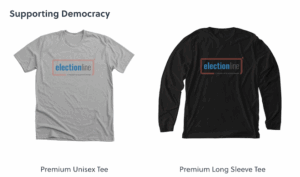 You’ve asked for it, well now you’ve got it! Just in time for all of your holiday gift-giving. We’ve opened up an electionline merch store using Bonfire. Currently we’re offering a couple of different t-shirts, a long-sleeve t-shirt and a hoodie.
Election News This Week
 Federal Update: The National Guard’s top general told Congress last week that it would follow the Constitution and the law when he was asked about the possibility President Donald Trump would order troops to polling places for the midterm elections. The remarks came at a U.S. House Appropriations subcommittee hearing. Rep. Joe Morelle, a New York Democrat, asked Gen. Steven Nordhaus, chief of the National Guard Bureau, what assurances he could provide to Americans concerned about the deployment of troops at the polls. “The National Guard, obviously, always follows the Constitution, law, policy and guidance, both at the federal and the state level,” Nordhaus said. Federal law prohibits the deployment of the military to polling places unless necessary “to repel armed enemies of the United States” and violations are punishable by up to five years in prison. A dozen Republican state attorneys general are moving to defend President Donald Trump’s executive order on mail ballots from legal challenges mounted by Democrats. The GOP officials, led by Missouri Attorney General Catherine Hanaway, argued in multiple court filings in response to Democratic lawsuits that the March 31 order provides states with “optional resources” to help secure their elections and doesn’t endanger voting rights. The states “would like to access this resource so they may verify the accuracy of their own voter-registration lists. This flow of information between federal and state agencies is a common and critical feature of our federal system,” the Republican officials wrote in a court document. The attorneys general of Alabama, Florida, Indiana, Kansas, Louisiana, Montana, Nebraska, Oklahoma, South Carolina, South Dakota and Texas joined Hanaway in the effort. POLITICO Magazine reached out to non-partisan voting experts with a simple but urgent question: What is one concrete, realistic step that should be taken now to protect the midterm elections? The experts proposed a mix of technical fixes, policy changes and public communication strategies, and most of them don’t need help from Congress or the president — they are things that state and local officials can be doing right now to ensure that November’s voting is seen as legitimate by all parties.
 Youth Vote: ChalkBeat (sister organization to Votebeat) has a story this week about young people attempting to vote in the Newark, New Jersey’s school board election, where the city’s 16- and 17-year-olds could participate for a second year in a row. What the 17-year-old didn’t expect was how much time and effort it would actually take to vote. “I thought I was at the right location, but I was told that I wasn’t. And then when I was finally at the right place to vote, the machine jammed when I tried to scan my ballot,” said Bah, a senior at Science Park High School. Meanwhile, 16-year-old Cidell Torto was told by a poll worker that she was too young to vote. “She literally told me you’re 16, you can’t vote,” said Torto, a junior at Science Park, who had to have an adult intervene to vouch for her voting right. As Bah and Torto tried to cast their ballots on Tuesday, they were met with confusion at polling sites, questions about their voting eligibility, and jammed machines. The two teens, along with their Youth Power Action Coalition peers, had been busy knocking on roughly 3,000 doors in the lead up to the Newark Board of Education election to inform their community about the upcoming race –– but they hadn’t counted on encountering those barriers. After a high-profile push to register 16- and 17-year-old voters last year, teen registration has dropped, with 1,524 signed up this year – down from last year’s 1,772 in 2025, according to the Essex County Superintendent of Elections. “There is just so much that people don’t see about getting youth to the polls,” said Amanda Ebokosia, founder and CEO of The Gem Project, a nonprofit organization that aims to strengthen youth civic engagement. She, along with student leaders, organized a “Ride to the Polls” event on Tuesday to ensure young voters had transportation to get to their voting site. That effort in itself took days to coordinate, as they had to get parental consent for students to ride buses and ensure students were fed and knew what to expect in the voting process.
 That’s a lot of stickers: Volunteers in Gallatin County, Montana are placing stickers over misprinted barcodes on tens of thousands of absentee return ballot envelopes to ensure they are delivered to the correct location. On April 21 it was discovered that the barcode on return ballot envelopes was incorrect and now volunteers are covering those up on 62,000 ballots. Eric Semerad, Gallatin County clerk and recorder and election administrator, explained how this happened. He stated that the secretary of state determines ballot formatting, and the misprinted barcode matches the secretary’s sample barcode. “So they’re programmed to go to a different location in Montana,” Semerad said. Fortunately, primary election ballots will not be mailed until the first week of May. Until then, volunteers will be placing stickers over the barcodes. “Without the barcode, the post office equipment can read our address and spray the correct barcode onto the envelope,” Semerad said. “If you look at how many volunteers are here — and let’s say each one does between 750 and 1,000 — that’s a lot of work. A lot of extra work, the election office got hit with,” said Kathie Scarrah, an elections office volunteer.
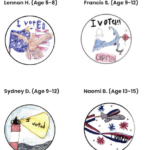 Sticker News: Congratulations to the four winners of the Harwich, Massachusetts “I Voted” sticker contest. Town Clerk Emily Mitchell established the contest to get younger kids involved in the democratic process and to dress up the standard “I Voted” stickers the town clerk’s office has been handing out to registered voters here who have cast ballots. The contest had four age categories. The contest directions stated “I Voted” must be prominently featured in the design. Designs must be non-partisan and should not refer to any political groups, slogans or issues. All designs must be original work, hand drawn on the provided entry form. Each entrant may submit only one design. The designs will be resized to fit a two-inch diameter sticker. “It was a total success,” Mitchell said of the participation by the young artists “It was such a joy, so great to see the kids’ creativity, and the kids coming in to vote, it was an introduction into democracy.” There was great participation from artists in the age categories and the community cast 295 votes in selecting the winners. Four winners were chosen in three categories. They were Lennon H. in age category 5 to 8; Francis S. and Sydney D. in age category 9 to 12; and Naomi B. in age category 13 to 15. Mitchell said there will be 1,000 stickers created for each of the four winning designs and they will be handed out to voters casting ballots at the
 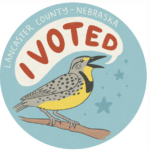 polls in the annual town election on May 19. Just how the various stickers will be distributed has not yet been determined, though Mitchell did say with four sticker designs, and there being four precincts in town, that could be a consideration. Congratulations to Katie Nieland, associate director of the Center for Great Plains Studies for winning the Lincoln County, Nebraska “I Voted” sticker contest. Nieland heard about the sticker design contest sponsored by the Lancaster County Election Commission and set about creating a design that represented both the election and Lancaster County as a place, settling on a drawing of the western meadowlark with a speech bubble reading “I voted.” “The meadowlark is a very identifiable bird because it’s our state bird, and it also has a very beautiful song, so I thought about instead of its normal song, what if it was saying I voted?” she said.
Personnel News: Rachel Brown has been appointed Wausau, Wisconsin city clerk. Garlin Gilchrist has won the Democratic nomination for Michigan secretary of state. Conway Belangia has been confirmed as the new executive of the South Carolina Election Commission. Grand Traverse County, Michigan Clerk Bonnie Scheele announced her retirement effective June 19.
New Research & Resources
Community Safety and De-Escalation Directory: Tools for non-violently navigating conflict are essential to a healthy democracy. To increase access to these resources, Bridging Divides Initiative created the Community Safety and De-Escalation Directory — an interactive platform to connect users with a curated network of community safety, de-escalation, and bystander intervention trainers from all around the country. Based on more than a year of feedback collected from trainers, trainees, and other ecosystem partners, our team has been working to expand the Directory, upgrade the mapping tool, and enhance the overall user experience. BDI recently launched the new and improved Directory, which now brings together more than 140 local and national training organizations in a streamlined interface that allows you to easily identify the resources available to your community. The Directory includes practitioners from all 50 states who can provide assistance across a wide range of issue areas, with support options now catalogued for quick search and filtering by sub-categories like protest marshal training, threat assessment training, digital security training, election-focused de-escalation training, LGBTQ+ community safety training, and more. “In our conversations with practitioners and community leaders, we’ve consistently heard that people are looking for better ways to identify training opportunities and connect with the right resource providers,” said Yvette Deane, BDI’s Community Safety and De-Escalation Lead. “The new Directory platform is going to be a big step in that direction, with an improved map and an expanded classification system that will make it easier than ever for people to find the tools they need to safely engage in civic spaces, from elections to Pride events.” The new Directory can equip users with practical frameworks for countering violence that both address the risk of immediate harm and help build a future where everyone feels safe.
Next Generation Initiative: The Next Generation Initiative is a national program designed to support and connect emerging leaders in local election administration. Local election administrators play a critical role in administering elections and maintaining public confidence in democratic processes. As the profession evolves, it is increasingly important to support the next generation of professionals entering the field. The initiative brings together a small national cohort of early-career election administrators to participate in professional development, peer learning, and cross-state collaboration focused on the challenges and opportunities facing election administration today. Participants engage in structured conversations and practical discussions designed to strengthen their day-to-day work while building a foundation for long-term career growth. The Next Generation Initiative is now accepting applications for its Founding Cohort, a highly selective national program supporting emerging leaders in local election administration. This inaugural cohort will bring together a small group of election administrators across the United States to engage in professional development, peer collaboration, and cross-state dialogue on the future of election administration. Selection is competitive and based on demonstrated commitment to the profession, meaningful contributions within one’s role, and a clear interest in continued growth and collaboration.
Certification Program: The U.S. Alliance for Election Excellence Certification Program is open and accepting applications from election offices. This new program offers your office the opportunity to earn certification in 11 voluntary, nonpartisan Standards for Election Excellence. This is an opportunity to both celebrate your team and continue improving the voting experience for your community. Through certification, your office can: Gain meaningful recognition for your team’s hard work; Build trust with your local community through third-party validation; Identify opportunities to fine-tune your processes; and Demonstrate your commitment to serving voters and running excellent elections. What makes this program unique is that it recognizes entire offices—rather than individuals—highlighting the collective effort that goes into running successful elections. The process is also fully online, requiring simple documentation of work in action—no classwork, no exams and no requests for confidential materials, live ballots or protected personal information about voters.
AI + Elections Clinic Skills Hub: This year, The Elections Group partnered with ASU’s Mechanics of Democracy Lab, Microsoft, International IDEA and Ready for Tuesday to reach a major AI and democracy milestone: the launch of the AI + Elections Clinic Skills Hub. It’s a microsite designed to connect elections officials, partners, technology experts, academics and students with practical AI resources, materials and tools built for modern-day election administration. The Skills Hub is intended to address the growing complexity and demands of election administration, with the goal of providing officials and experts with secure, functional and innovative resources tailored to our field’s practical needs.
Ballot Measures, Legislation & Rulemaking
 Federal Legislation: According to Roll Call, the SAVE Act, for the moment, has essentially been abandoned in the Senate. Five weeks ago, Senate Republicans said they were bracing for an extended fight as they kicked off debate on their marquee election overhaul bill. Now, they have quietly set it aside. The question is: For how long? And is there an appetite to return to debating a bill that currently doesn’t have a chance for passage? It’s unclear what the future looks like for the legislation, which would require proof of citizenship to register to vote and photo ID at the polls. Republicans haven’t garnered the Democratic support they would need for passage under the chamber’s 60-vote threshold. Nor has the “extended floor debate” changed the minds of most Senate Republicans when it comes to blowing up the chamber’s rules on the filibuster to lower that threshold to 51. The Senate had planned to stay on the legislation, but new priorities with impending deadlines sucked much of the oxygen away from it once they returned last week from their spring recess. Senate Majority Leader John Thune, R-S.D., confirmed the Senate would “pivot away” from the SAVE America Act, Lee’s sweeping election reform bill to ban noncitizens from voting and implement photo ID requirements in order to vote in federal elections. Lee triggered a floor takeover last month to keep the legislation as the only pending business in the Senate, a move that will now be overturned in order to turn focus to Homeland Security funding and national security talks. Majority Leader Thune said the Senate can return to debate on the SAVE America Act once those bills are passed, but Lee confirmed to the Deseret News that they “don’t have a firm timetable.” “Right now, we’re dealing with a number of privileged vehicles,” Lee said. “And I understand there are some things that because of their emergent nature or because of their privileged status, sometimes they have to get put to the front line. But nobody has said we’re not doing (SAVE America Act), and I don’t think anyone should expect that we’re not doing it.”
 Alabama: Alabama is working to make it easier for former inmates to restore their voting rights through a bill signed by Gov. Ivey on April 16. Senate Bill 24 says that the Board of Pardons and Paroles has to have information about how people can restore their voter registration after a conviction. The site would allow Alabamians to search their status using their given Alabama Institutional Serial number. There would be instructions to electronically submit their voting eligibility certification.The bill got bipartisan support in the senate, while a handful of House Republicans abstained from the vote, and three House Republicans voted ‘no.’ “I do think that it’s going to make a difference in just the confidence building of people who have been through that process and are out on their own,” said Sen. Linda Coleman-Madison (D-Birmingham).
 California: Legislative Democrats on the Assembly Elections Committee advanced a bill last week aimed at keeping armed officers away from polling places and daycare facilities. AB 2230 would prevent any armed or uniformed individual from being stationed within 100 feet of a voting location or childcare center unless they are responding to a specific public safety incident. Deploying ICE agents or armed officers to polling places and vote centers during an election is already illegal, according to the Brennan Center for Justice. Yet, Democrats argue the bill is still needed to protect eligible voters from possible intimidation, especially following the widespread immigration crackdown that played out in Southern California last summer. The bill passed on a 6-2 party line vote and heads next to the Assembly Public Safety Committee.
 Connecticut: A protracted debate on a bill that would make voting by absentee ballots a universal option in Connecticut ended without a vote April 22 in the House of Representatives. Republicans prolonged the debate late into the night, a protest against Democrats’ refusal to accept an amendment that would have reduced the current 14-day period of early in-person voting period by half, as some municipalities have requested. House Speaker Matt Ritter, D-Hartford, said Democrats temporarily ended the debate with a view towards exploring a compromise before calling the bill for a vote, possibly April 23. House Bill 5001 would repeal a law that now denies absentee ballots to any voter who cannot attest to being unable to vote in person due to sickness, disability, absence, military service, religious conflicts or being an elections worker. Until the passage of a constitutional amendment in November 2024 by a margin of 58% to 42%, those six conditions were part of a state constitution that was unusually prescriptive on rules for absentee voting.
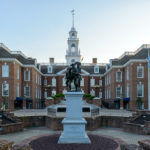 Delaware: A bill to update multiple parts of election code got bipartisan Senate support during a floor vote this week. State Sen. Dan Cruce’s SB 266 has nine sections that update state election code. He said American citizens’ access to elections is “paramount.” Anthony Albence, Delaware’s election commissioner, said the bill requires that any software Delaware uses already be used by two other US election jurisdictions. How the state evaluates jurisdictions isn’t specified in the bill. “…but we would be looking at jurisdictions of similar size and capacity of the state and our particular types of machines,” Albence said. “And (Delaware’s) family of machines are used in a lot of jurisdictions in the country.” The state adopted a new electronic voting system and requirements in 2019. Cruce said his legislation is an update based on feedback that’s happened since. Other sections of the bill get into more technical revisions. Section four provides clarifies standards for counting absentee ballots. Another of those technical changes repeals a procedure that asks voters to cast provisional ballots when a court orders a polling place to be kept open late on election day. The bill heads to the House for consideration. If passed and signed into law, the changes would go into effect upon enactment.
 Delaware Executive Order: Delaware is taking steps to ensure that elections are held securely, and that voters can have confidence in the system. Governor Matt Meyer signed Executive Order 19 to establish the Task Force on Free, Fair and Secure Elections. He said the action also is designed to safeguard the state from unconstitutional federal interference. “The basic concept of one person, one vote is being threatened, and it’s not an accident,” Meyer said, referring to some calls to federalize elections. “We will be better prepared than any other state for whatever comes our way, whatever craziness comes our way this fall.” The Election Security Task Force will be co-chaired by Secretary of State Charuni Patibanda-Sanzhez and Secretary of Safety and Homeland Security Joshua Bushweller. Representatives of various agencies, law enforcement and in the cybersecurity field will be part of the task force. It will have regular meetings and will issue recommendations and reports before the primary and general elections, in addition to providing a comprehensive post-election assessment.”
 Lansing, Michigan: The Lansing City Council approved a resolution opposing federal voting requirements. The resolution, passed this week, specifically opposes requiring proof of citizenship for voter registration or voting, setting up a potential conflict if federal legislation like the SAVE Act becomes law. Lansing City Clerk Chris Swope, who has overseen elections for two decades, argues that citizenship proof requirements would create more problems than they solve. “The number of non-citizens who vote is so minuscule, especially when you compare it to the number of people who are not going to have this documentary proof,” Swope said. Swope worries that requiring documents like birth certificates or passports would disenfranchise legitimate voters who may not have easy access to such paperwork. The resolution also touches on broader voter ID debates. While Michigan law requires photo identification at polls, voters can sign an affidavit if they don’t have ID with them. The resolution positions Lansing as opposing federal voting changes, but any actual implementation would depend on federal legislation and potential legal challenges.
 New York: The Senate Elections Committee has advanced legislation that would expand language access protections for Creole speakers and other communities under state voting rights law. The committee approved the bill, sponsored by Sen. Zellnor Myrie, on April 21. The measure would add Creole speakers and New Yorkers of Middle Eastern and North African descent as protected groups under the John R. Lewis Voting Rights Act of New York. The law allows designated groups to challenge voter suppression or dilution in court and requires jurisdictions to provide language assistance in certain cases. More than 170,000 Creole speakers live in New York state, according to estimates and over 300,000 residents report Middle Eastern or North African ancestry.
 North Carolina Rulemaking: Elections officials in North Carolina counties may soon be able to challenge “potential noncitizens” on their voter rolls, a move that detractors say will burden citizens called to government offices to show documents. The proposed election rule is part of the Republican-run election board’s intensified effort to find people who are not U.S. citizens who may be registered to vote. The State Board of Elections adopted the new rule with a 3-2 party-line vote, establishing a procedure for verifying the status of people on the voter rolls who may not be citizens. It’s a step the board is taking as it anticipates getting lists of names from the federal government’s SAVE database. Under the proposed procedure the state elections board endorsed Thursday, when people are flagged as potential noncitizen registrants, their county’s elections administrators will be notified and will search their own records for proof of citizenship. If they can’t find any, people flagged would be called in to preliminary hearings to show documentation. If there’s a question after the preliminary hearings, the county boards will hold challenge hearings. The North Carolina Rules Review Commission must approve the new procedures before they can be used.
 Rhode Island: House State Government and Elections Committee unanimously recommended passage of a bill requiring Rhode Island’s presidential primary elections to be held on the first Tuesday in March — or “Super Tuesday” — beginning in 2028. In 2024, Rhode Island held its presidential primaries on April 2. If the bill is passed, Rhode Island will join the 16 states and one territory that hold primaries or caucuses on Super Tuesday. The bill has garnered bipartisan support from R.I. politicians.
In other election date legislation, the state’s primary elections will now be held on Wednesday, Sept. 9, moving it back from the typical Tuesday election day because it fell too close to Labor Day. Gov. Dan McKee, a Democrat, signed off on the change earlier this week. The primary election had been scheduled for Sept. 8, which is the day after the holiday weekend.
Legal Updates
 Federal Litigation: Common Cause and four voters sued the Justice Department this week to block it from compiling a national voter database that the watchdog warns allows the government to surveil and disenfranchise millions of Americans. Common Cause, represented by the American Civil Liberties Union for D.C., argue the database’s creation and its use of the Department of Homeland Security’s Systemic Alien Verification for Entitlements system clearly violates federal statutes, the separation of powers doctrine and the Constitution. “The U.S. Department of Justice has launched an illegal and unprecedented quest to stockpile millions of Americans’ confidential voter data in a system of records within its Civil Rights Division,” Common Cause claims in the 58-page lawsuit. “Never before has a federal agency centralized this volume of Americans’ voting data in a single system of records. And in so doing, DOJ has flouted statutory safeguards designed to ensure transparency and public participation in the federal government’s collection of Americans’ personal information.” Since President Donald Trump’s return to office, the Justice Department has demanded 48 states and the District turn over unreacted statewide voter registration lists, many of which contain sensitive information such as Social Security numbers, driver’s license numbers, signatures, birth dates, addresses, places of birth, party affiliation and voter history. To date, the Justice Department has sued the District and the 30 states that have pushed back on the demands in full, including: Arizona, California, Colorado, Connecticut, Delaware, Georgia, Hawaii, Idaho, Illinois, Kentucky, Maine, Maryland, Massachusetts, Michigan, Minnesota, Nevada, New Hampshire, New Jersey, New Mexico, New York, Oklahoma, Oregon, Pennsylvania, Rhode Island, Utah, Vermont, Virginia, West Virginia, Wisconsin and Washington. According to Common Cause, the Department of Homeland Security “haphazardly” expanded its SAVE system, which was previously a limited tool for certain immigration-related databases, to conduct mass citizenship checks based on unreliable data. “The faulty new system and flawed comparison methodology has already falsely identified significant numbers of U.S. citizens as noncitizens, imperiling their fundamental right to vote,” Common Cause said. “And the system has proven especially unreliable for citizens born outside of the United States (e.g., naturalized, derived and acquired citizens), who are at a higher risk of being falsely identified as noncitizens.”
 Alaska: Voting and civil rights groups sued Alaska elections officials, alleging that their sharing of the state’s full voter registration list with the U.S. Department of Justice violates the state constitution. The Alaska lawsuit was filed in state court against state Division of Elections officials by the League of Women Voters of Alaska and Alaska Black Caucus. It alleges the handing over of personal data on the voter list violates the right to privacy under the state constitution. It also says the memorandum of understanding violates due process by allowing the Justice Department to flag voters for removal “without any apparent notice or process for impacted voters to challenge those decisions.” The lawsuit names as defendants Republican Lt. Gov. Nancy Dahlstrom, who oversees the division, and division Director Carol Beecher. Sam Curtis, a spokesperson with the state Department of Law, said by email that it would be premature to comment on specific claims raised in the lawsuit. But Curtis said the department has previously explained in public hearings that state law “expressly permits the sharing of this information for authorized governmental purposes. That statute is on the books, and we will defend it.”
 Arizona: Maricopa County Recorder Justin Heap (R) will be given more authority in running elections after a judge sided with his office in a prolonged legal fight with the local board that shares responsibility for overseeing the vote. Heap sued the predominantly Republican county board of supervisors last summer, alleging it had illegally taken control of certain aspects of election administration. Heap claimed the board transferred funding, IT staff and some key functions – including management of ballot drop boxes and establishing early voting sites – away from his office through an agreement negotiated with his predecessor, whom he had recently defeated in a GOP primary. Maricopa County Superior Court Judge Scott Blaney mostly sided with Heap’s office in his ruling. The board of supervisors “acted unlawfully and exceeded its statutory authority by seizing the recorder’s personnel, systems and equipment and refusing to return them” to the recorder, he wrote. Blaney also ruled that the recorder’s office is responsible for overseeing in-person early voting, among other duties, while the board is responsible for other operations, such as selecting election day voting locations, supplying polling locations and hiring poll workers. “The board’s assertion of plenary authority over election administration through its general supervisory powers is inconsistent with Arizona law,” the judge wrote.
 California: Laura Lee Yourex, 63 of Costa Mesa, will be sentenced in October for registering her dog to vote in what she claimed was an attempt to expose election fraud. Yourex pleaded guilty April 10 to misdemeanor knowing registration of a nonexistent person to vote. As part of her plea deal with prosecutors, felony counts of perjury, procuring or offering a false or forged document to be filed, registered or recorded, and not being entitled to vote at an election were dismissed. She is scheduled to be sentenced Oct. 16. Yourex illegally cast ballots in her dog’s name in the 2021 gubernatorial recall election and 2022 primary election, according to the Orange County district attorney’s office. Orange County Registrar of Voters Bob Page said his office was alerted to the fraud by former Huntington Beach City Atty. Michael Gates, who went on to work as an attorney with the civil rights division of the U.S. Justice Department. He has since left that post. “I received an email from former Huntington Beach City Atty. Michael Gates who said a voter talked to him and shared that her dog received a ballot,” Page said. “I quickly referred that to the district attorney to investigate.’’
 Indiana: The law banning the use of public university student identification cards for voting is back in effect after an order from the U.S. Court of Appeals for the Seventh Circuit — as early voting for the state’s May 5 primary continues. A federal judge last week blocked enforcement when he granted a preliminary injunction sought by voter advocates alleging the ban “deliberately abridges young voters’ right to vote.” The plaintiffs include Count Us IN, Women4Change Indiana and Indiana University student Josh Montagne. The day after the injunction was set, Montagne used his student ID to vote on IU’s Bloomington campus, he confirmed to the Indiana Capital Chronicle. The state of Indiana filed an emergency motion for a suspension of the preliminary injunction. The appeals court granted the motion, pending appeal, and promised a “reasoned decision” within two business days. The state has maintained in court filings that the ban would impact a small number of students and that any burden created by the change is “minimal.” The judge and plaintiffs estimated between 40,000 and 90,000 students in Indiana could be affected.
 Kansas: Former Coldwater Mayor Joe Ceballos reached a plea agreement with the Kansas Attorney General’s Office to drop the severity of charges related to voting illegally from six felony counts to three counts of disorderly election conduct, each a class B nonperson misdemeanor, court documents said. Ceballos is a legal permanent resident of the United States and a citizen of Mexico. During the interview process in 2025 to become an American citizen, Ceballos said he had voted in the past, which triggered his arrest. The plea agreement, finalized in Comanche County District Court, means deportation proceedings aren’t likely although that’s never off the table, said Ceballos’ attorney, Jess Hoeme. “Normally a felony or a crime of moral turpitude punishable by up to a year in jail would be the kinds of dispositions in a case that would prompt removal proceedings,” he said. “We were able to completely avoid that.” Ceballos won’t serve jail time and will pay a fine of $2,000, Hoeme said. He was given a six-month underlying sentence on each count, which was suspended, according to the plea agreement.
 New Hampshire: New Hampshire’s secretary of state is pushing back against the federal government asking a judge to dismiss a lawsuit over access to the state’s voter database. The U.S. Department of Justice filed the lawsuit after the state refused to turn over a full voter list. In filing a motion to dismiss the lawsuit, state officials said they are protecting voters’ information, arguing that the federal government is asking for things that are personal and that the state is not allowed to give out. The lawsuit calls for the state to hand over voter data, including names, addresses, dates of birth and either a driver’s license number or the last four digits of a Social Security number. The federal government says it needs the data to check elections, but the state says it’s not required or allowed to share the information. “The state law is very clear that confidential voter data, data that is not part of the public checklist, is to be kept private and confidential,” Secretary of State David Scanlan said. “And that’s my charge.” A hearing on the matter has been scheduled for April 29.
 Rhode Island: U.S. District Court Judge Mary McElroy dismissed a Trump administration lawsuit demanding detailed voter data from Rhode Island, a decision that follows similar rulings in a handful of other states. McElroy sided with Rhode Island’s top election officials and civil rights advocates, writing that federal law does not permit the U.S. Department of Justice “to conduct the kind of fishing expedition it seeks here.” McElroy’s decision is similar to other rejections by federal judges across country since the Justice Department began seeking detailed voter data from the states. The information includes dates of birth, addresses, driver’s license numbers and partial Social Security numbers. “The executive branch seems to have no problem taking actions that are clear Constitutional overreaches, regularly meddling in responsibilities that are the rights of the states,” Rhode Island Secretary of State Gregg M. Amore said in a statement. “But the power of our democratic republic, built on three, coequal branches of government, is clearer than ever before.”
 South Carolina: The South Carolina Supreme Court heard arguments this week in the unresolved dispute over the 2023 Atlantic Beach mayoral election during a live-streamed hearing. The court is tasked with deciding if a circuit court judge erred in upholding the municipal election commission’s finding that a new election was required after fraudulent ballots were discovered. The dispute stems from the November 2023 mayoral election in Atlantic Beach, where candidates Josephine Isom and John David were vying for the office. After an initial vote count showed Isom leading, 19 provisional ballots were added, with 18 of them counted, shifting the totals to favor David. Isom challenged these provisional votes, and 14 were later found to be fraudulent, prompting the municipal election commission to order a new election because the ballots were mixed and could not be separated. Isom’s attorney, Kenneth Davis, argued that a winner could have been declared without a new election. Davis contends that since the 14 fraudulent ballots were known to come from the provisional votes, with two cast for Isom and the rest for David, simple math could determine the outcome was 62-53 in favor of Isom.
 Texas: Some Dallas County Republicans sued the county elections department in a bid to require voters to cast ballots for the May 26 primary runoff at specific polling places in their precincts rather than any location in the county. That precinct-based voting system on primary election day in March created chaos. Local party leadership is trying to reverse a decision made by its former chair, who resigned last week after facing backlash for agreeing to use countywide voting on election day in the runoff. But early voting for the runoff election starts May 18, and Dallas County election officials say it’s too late to change course. The lawsuit, filed in the Texas Fifth Court of Appeals by Barry Wernick, a Republican precinct chair and a candidate for Dallas County Commissioner District 2, is asking the court to require the county to use precinct polling places for the runoff election. Wernick is arguing the former party chair, Allen West, didn’t have the authority to agree to the use of countywide voting. Thirty-one party members signed declarations supporting the lawsuit, according to the filing. In addition, the county party’s executive committee voted in favor of using precinct polling places for the runoff election.
 Wisconsin: The Wisconsin Supreme Court heard oral arguments this week in a case brought by a conservative group that could determine whether sensitive information about people judged mentally incapable of voting is a public record. It’s the second time justices heard arguments in this case, which previously had been caught up in conflicting opinions issued by two of the state’s appeals court districts. It also became an attack point used by liberal Appeals Court Judge Chris Taylor in the most recent Wisconsin Supreme Court election, which she won by 20 points. Her opponent, Appeals Court Judge Maria Lazar, wrote an opinion supportive of the conservative group’s position, which was unusual because it contradicted another appeals court ruling in a separate case on the same issue. The key question before justices is whether the information in Notices of Voting Eligibility should be publicly accessible. Courts send those forms to election officials after a judge in a guardianship case determines someone is not competent to cast a ballot. State law says “the fact that an individual has been found incompetent … is accessible to any person who demonstrates to the custodian of the records a need for that information.”
 Wyoming: District Court Judge Michael McGrady dismissed proceedings to determine whether Becky Hadlock, who resigned earlier this month as Weston County clerk, should be removed from office for her conduct during and after the 2024 general election, court records show. McGrady granted a motion by both parties to dismiss the case April 16, one week after Hadlock resigned from office. Hadlock resigned April 9, one day after she was arrested and charged with violating the election code as an official and one count of falsifying election documents. Both are felonies that carry maximum penalties of up to five years in prison. “The Parties declare that [Hadlock] has resigned from the office of Weston County Clerk, effective April 9, 2026, and the Weston County Commissioners confirmed the finality of [her] resignation by formally declaring the office vacant on April 14, 2026. These actions have rendered the petition for removal of [Hadlock] moot,” according to the filing filed by both parties in the case seeking its dismissal. “The parties therefore agree and stipulate that this action is dismissed with prejudice, with each party to bear their own costs.” Since the court granted the motion, the case is now closed.
Opinions This Week
National Opinions: Secretary of state races
Arizona: Vote by mail | Maricopa County
California: SAVE Act | Ballot counting
Colorado: Voting system
Connecticut: Absentee voting
Georgia: Special session
Hawai’i: Vote centers
Idaho: Latah County
Indiana: Poll workers | Turnout
Maine: Susan Collins
Minnesota: Absentee voting
Nevada: Election performance
New Mexico: Ranked choice voting
North Carolina: Buncombe County | Cumberland County
Ohio: Mahoning County | Ranked choice voting |
Texas: Dallas County
Wisconsin: Trust in elections
Upcoming Events
Request for Comment: Election Audit Standards: The U.S. Election Assistance Commission (EAC) is requesting public comment on the Voluntary National Election Audit Standards. Election audits are used to evaluate and improve the accuracy, security, and administration of elections. Because election administration in the United States is highly decentralized, audit practices vary across states and local jurisdictions. The proposed standards provide voluntary, principle-based guidance intended to be adaptable across differing legal frameworks, election systems, and resource environments. When: April 27. Where: Online.
Kansas County Clerks and Election Officials Association: The 2026 Annual KCCEOA Conference will be April 28-May 1 at the Refinery in Garden City. When: April 28-May 1. Where: Garden City.
2026 EAC Board of Advisors Annual Meeting: The U.S. Election Assistance Commission (EAC)’s Board of Advisors will host an in-person public meeting on April 28-29, 2026, in the agency’s hearing room. During the meeting, members will conduct regular business and discuss EAC updates and upcoming programs. The Board of Advisors is a 35-member board composed of representatives from various EAC stakeholder associations, federal government agencies, and Congress. If you are a member of the public and you are interested in attending, please register below. Information on how to submit written comments is forthcoming. When: April 28 & 29. Where: Washington, D.C.
Securing the Vote: Global Lessons for U.S. Election Officials: This conversation will explore what U.S. election officials can learn from how other countries approach election administration, security and democratic resilience. Featuring international experts, it offers a global perspective on practices and lessons that may inform election work here. Books and Ballots is a partnership among Ready for Tuesday, the Center for Election Innovation and Research (CEIR), and the MIT Election Data and Science Lab. When: April 29, 2pm Eastern. Where: Online.
Practical AI Risk Management: Measuring AI in Election Offices: Join Ready for Tuesday for a conversation on artificial intelligence tailored for election practitioners and administrators. Using the National Institute of Standards and Technology (NIST) AI Risk Management Framework (AI RMF) as our guide, we’ll focus specifically on the Measure phase. The Measure function is about analysis and evaluation: examining how AI systems actually perform, whether they behave as intended, and what the evidence tells you about the tools you’re using. When: May 1, 12pm Eastern. Where: Online
Safeguarding Election Officials: Practical Strategies for Managing Doxing Risks: You run elections. You should not have to choose between doing your job and keeping your family safe. Doxing, the deliberate exposure of personal information online, is a real threat. But it is also one you can get ahead of. Your digital footprint can be reduced. Your exposure can be managed. And with the right tools, you and your team can take meaningful steps to protect yourselves before an incident ever occurs. On May 1 at 1:00 PM ET, the Election Security Exchange is bringing together three of the most credible voices in this space to give you a clear picture of how doxing works, who is behind it, and, most importantly, what you can do about it right now. When: May 1, 1pm Eastern. Where: Online.
Beat Academy: Midterm Prep: Great Lakes journalists! Work on coverage strategies, gain reporting tools and spark regional connections in our free election coverage workshop in Detroit (May 5) or Indianapolis (May 7), 9 a.m. to 4 p.m. Learn to respond to misinformation, do candidate research, report on key election drivers like immigration and affordability, and produce salient coverage that puts voter interests first. By the end of this workshop, you will: Learn how to respond to misinformation and efforts to undermine fair elections. Verify candidate backgrounds via tools and databases. Explore regional factors shaping Great Lakes midterm races. Develop coverage strategies for key election drivers like immigration and affordability. Generate story ideas and prioritize voter interests in your reporting. When and Where: May 5 (Detroit) and May 7 (Indianapolis).
Ready or Not: Election Administration Wins, Woes & What’s Still Coming in 2026: Election administrators have a lot on their plates in 2026 — and the year is far from over. From new legislation and technology changes to funding battles and workforce challenges, the field is shifting faster than ever. Join Ready for Tuesday May 5, at 12 p.m. for a candid, freewheeling conversation about the wins worth celebrating, the woes keeping administrators up at night, and the challenges and opportunities that are still taking shape on the horizon. We’ll dig into what’s gone right, what’s gone wrong, and what nobody quite knows yet. Whether you’re deep in the trenches of election administration or just trying to keep up with a rapidly evolving landscape, this webinar will give you an honest, engaging look at where things stand heading into the back half of 2026 — and what you should be watching for next. When: May 5, 12pm Eastern. Where: Online
Washington Association of County Auditors: The Washington Association of County Auditors will hold its annual conference from May 12-14 in Snohomish county.
2026 IIMC Annual Conference: The International Institute of Municipal Clerks will be holding its Annual Conference from May 17-21 in Reno, Nevada. When: May 17-21. Where: Reno.
Building Disaster Resilience for Community Leaders: Disaster Preparedness for Election Offices: Join Ready for Tuesday for this Natural Disaster Awareness for Community Leaders course and increase your understanding of disasters, risk assessment in the context of disaster management, prevailing emergency management procedures and operations, and the different vulnerability factors that exist within your local community. Become familiar with the available resources for natural disaster preparedness and planning. Learn how to recognize and define the roles and responsibilities that may be expected to be assumed by a community leader and understand the roles that first responders and other support personnel are likely to assume to ensure assistance in the response and recovery phase of an emergency event. This course will use election office events as a series of case studies to help connect emergency management challenges to election administration. Feel free to invite your local emergency management partners to join this no-cost training. This course is hosted by Ready for Tuesday, Advance Elections and Portland State University’s Elections & Voting Information Center. The four-hour course is offered at no-cost to participants, and upon successful completion of the course a certificate will also be issued. When: May 28, 12pm Eastern. Where: Online
NMC Annual Conference: New Mexico Association of Counties- Clerks Affiliate will hold its annual conference from June 15-18 in McKinley County.
AAMCA Summer Conference: The Alabama Association of Municipal Clerks and Administrators will hold its summer conference from June 24-26 in Fairhope.
2026 NACo Annual Conference & Exposition: The National Association of Counties will hold its 2026 Annual Conference & Exposition on Orleans Parish, Louisiana from July 17-20. When: July 17-20. Where: New Orleans.
NASED 2026 Summer Conference: The National Association of Directors of Elections will hold its summer conference from July 20-22 in Boston. When: July 20-22. Where: Boston.
iGO 9th Annual Conference: The International Association of Government Officials will hold its 9th Annual Conference from July 25-28 in Reston, Virginia. When: July 25-28. Where: Reston, Virginia.
2026 NCSL Legislative Summit: The 2026 NCSL Legislative Summit takes place in Chicago July 27-29, bringing together state legislators and legislative staff from all 50 states and U.S. territories for three days of collaboration, innovation and bipartisan dialogue. When: July 27-29. Where: Chicago.
SCARE 2026 Annual Conference: The South Carolina Association of Registration and Election Officials (SCARE) will hold its annual conference from July 27-30 in Isle of Palms.
Oregon Association of County Clerks: The Oregon Association of County Clerks will hold its annual conference from August 10-13 in Burns.
WMCA 46th Annual Conference 2026: The Wisconsin Municipal Clerks Association will hold its annual conference from August 18-21 in Green Bay.
Election Center 41st Annual Conference: The National Association of Election Officials (Election Center) will hold its 41st Annual Conference in Kansas City, Missouri from August 19 to 21. CERA classes will be offered August 22 and 23. When: August 19 to 21. Where: Kansas City, Missouri.
UAC Annual Convention: The Utah Association of Counties will hold its annual convention from September 8-10.
2026 WACO Conference: The Wyoming Association of County Officers-County Clerks will hold its annual conference from September 22-24 in Laramie.
2026 MACO Annual Conference: The Montana Association of Counties will hold its annual conference from September 27-30 in Helena.
Job Postings This Week
electionlineWeekly publishes election administration job postings each week as a free service to our readers. To have your job listed in the newsletter, please send a copy of the job description, including a web link to mmoretti@electionline.org. Job postings must be received by 5pm on Wednesday in order to appear in the Thursday newsletter. Listings will run for three weeks or till the deadline listed in the posting.
Assistant Secretary of State, Mississippi–The Elections Division has many roles in assuring that Mississippians’ voices are heard clearly through the election process. These roles include training election officials, collecting campaign finance and lobbying reports, managing the statewide voter registry, collecting election returns, and assisting local election officials in carrying out their election-related responsibilities. Application: For the complete job listing and to apply, click here.
Clerk II, Dallas County, Texas–Performs a variety of moderately complex support tasks which may include: inputting, processing and distributing a variety of documents and records; collecting, compiling, filing and maintaining data; reconciling data, funds or inventory; and interacting with the public to provide excellent customer service. Works within a well-defined framework of policies and procedures, under moderate supervision. Responsibilities: 1. Receives, prepares, verifies and processes a variety of documents, instruments, records, bills, payments and receipts. 2. Inputs data to complete routine correspondence, forms, reports and documents. 3. Researches, locates, pulls and prepares a variety of documents, records and other assigned data. 4. Effectively answers routine inquiries and resolves basic customer service issues. 5. Collects, inputs, updates and reconciles data, funds or inventory and maintains filing/storage of documents and supplies. 6. Performs other duties as assigned. Salary: $17.30-$21.26/hr. Deadline: May 13. Application: For the complete job listing and to apply, click here.
Communications Officer, San Bernardino County – San Bernardino County Registrar of Voters is seeking a Communications Officer to lead the development and coordination of internal and external communications, media and public relations, and marketing initiatives for the department. This role is responsible for preparing press releases, public service announcements, articles, bulletins, reports, and informational materials such as brochures, as well as supporting presentations and community education and outreach efforts. The Communications Officer oversees a broad range of communication and information activities, serves as a liaison between executive leadership, management, and media representatives, and responds to inquiries from the media, public, and partner agencies. Salary: $76,752.00 – $105,580.80 Annually. Deadline: May 1. Application: For the complete job listing and to apply, click here.
Director of Election Security, Apollo Information Systems–The Director of Election Security is a seasoned election expert who is passionate about protecting our Nation’s democratic infrastructure and ready to own a high impact area of the business. This is a strategic leadership position and responsible for shaping and growing our election security offerings. The Director will serve as the architect of our program portfolio and its external face. This person will be engaged in sales conversations, speak at industry conferences, and build credibility while driving revenue. The Director will be a decision maker around service offerings and lead client engagements to ensure our solutions are tailored and scalable. The ideal candidate brings deep election security experience and a hunger to build something that matters. Salary: $135K – $155K. Application: For the complete job listing and to apply, click here.
Director of Voter Services, Chester County, Pennsylvania– The Director of Voter Services plans, organizes, supervises, and manages the activities of voter registration, campaign finance, and elections for the County of Chester in compliance with all federal, state, county, and local laws. Essential Duties: Election operations, Department leadership and administration, Communications and public engagement and other. Salary: $119,043.06 Annually. Application: For the complete job listing and to apply, click here.
Election Assistant, Olmsted County, Minnesota–Under supervision, assists with Olmsted County’s election process. Provides customer service to voters in person and via mail. Answers phone calls, directs the public to polling places, monitors supplies, and answers questions. Supports a diverse, respectful, and inclusive workplace. Examples of Work: Assists voters with the absentee voting process; Performs clerical duties including customer service, filing, answering phone calls and data entry to support the election process; Assists on Election Day by answering questions, monitoring supplies, and directing traffic; Processes absentee records on a statewide system; Prepares equipment and supplies for Election Day; Assists with election judge training; and Performs other related job duties as assigned. Salary: $21.30 – $35.59 Hourly. Application: For the complete job listing and to apply, click here.
Election Hardware Manager, Dallas County, Texas–Manages the lifecycle of election hardware by developing and maintaining processes, policies, systems and measurements. Manages the election hardware inventory; ensures quality control by assigning and deploying equipment; recommends, implements, and utilizes automation and tools to monitor and report on inventory; records and manages licenses, service agreements, and warranties for election hardware and related software/firmware; reviews, analyzes, and evaluates election hardware operations. Management Scope: Manages up to 5 staff. Responsibilities: 1. Establishes and maintains an inventory of election related assets to include but not limited to ballot marking devices, ballot counters, electronic poll books, mobile networking equipment, computers/laptops, mobile devices, tablets, and related software and peripherals. 2. Plans, monitors, and enforces the usage, tracking, and health of election hardware and software. 3. Plans, monitors, and enforces configuration of election hardware to include installed software, security configuration, and election specific programming/configurations. 4. Provides regular reports and analysis on asset usage and related costs. 5. Documents and provides guidance and training on the usage, tracking, and maintenance of election hardware and related peripherals and software in coordination with vendors and election staff. 6. Manages, trains and guides the work of staff in preparing, deploying, and supporting election hardware. 7. Performs other duties as assigned. Salary: $5675-$7079/month. Deadline: May 6. Application: For the complete job listing and to apply, click here.
Election Hardware Technician, Dallas County, Texas– Prepares election equipment, including equipment inventory, installation, programming, deployment, repair and testing. Serves as the helpdesk technical support during elections. Management Scope: Supervises up to ten (10) part-time employees. Responsibilities: 1. Programs, tests and prepares election equipment to conduct public logic and accuracy testing of election media devices, ballot marking devices, tabulators and software. b2. Maintains election equipment by troubleshooting, repairing and replacing defective parts or equipment to ensure compliance of voting regulations and safety guidelines. Cleans and stores ballot boxes, voting storage carriers, computers and other equipment; audits and logs voted and unused ballots; orders and maintains parts and supplies. 3. Tests and coordinates the set-up of election equipment, election computer systems, workstations and supplies to meet specification of voting system. 4. Supervises and trains part-time employees. 5. Maintains election equipment inventory and updates election equipment software. 6. Assists on Election Day by serving as the helpdesk representative, responding to problematic calls, instructing election judges and clerks on voting equipment operations, and preparing equipment and supply handouts 7. Performs other duties as assigned. Salary: $22.47-$28/hr. Deadline: May 6. Application: For the complete job listing and to apply, click here.
Election Manager-Election Systems, Shawnee County, Kansas– Under general supervision, this Classified position is a part of the Election Office’s management team. Performs critical administrative work for elections related to election systems including voting machines and the associated software, electronic poll books and the associated software, and election management software for tracking races, candidates, and polling places. MINIMUM QUALIFICATIONS • High School Diploma or GED Certificate. • Three (3) years’ office administration or election office experience. • Three (3) years’ database operations/software application experience. • One (1) year of supervisory experience. • Valid Driver’s License and able to operate a County-owned vehicle (HR 2013-2). Salary: $26.10 – $28.81 /hr. Application: For the complete job listing and to apply, click here.
Election Program Specialist, City of Richmond, Virginia – The Office of Elections is seeking to hire Elections Program Specialist. The incumbent will provide program and technology support to various staff in the elections office. Incumbent will coordinate maintenance and troubleshooting of election programs and work in conjunction with Virginia Department of Elections staff, local government staff, vendors, and contractors to resolve program issues. This incumbent will not supervise other positions and will report to the Deputy General Registrar. Salary: $51,667.20 – $75,483.20. Deadline: April 28. Application: For the complete job listing and to apply, click here.
Election Protection Hotline Specialist, Lawyer’s Committee for Civil Rights Under Law– The Hotline Specialist position is part of our hotline team, which oversees the day-to-day functions of the 866-OUR-VOTE Hotline, as well as providing support to state-based contact centers. This position will work to support thousands of legal volunteers who respond to voter questions. The Election Protection Hotline Specialist works under the supervision of the Election Protection Senior Technical Hotline Specialist and Election Protection Infrastructure Manager. This job is directly related to elections and is fast paced, requires multi-tasking, and includes early morning, evening and weekend work. This position requires comfort with learning and using new technology and platforms. Candidates with previous campaign experience or previous Election Protection experience are encouraged to apply. Application: For the complete job listing and to apply, click here.
Election Support Aide On-Call, Olmsted County, Minnesota–Recognized as one of the best places to work in Southeast Minnesota for three consecutive years, at Olmsted County every role helps to foster a vibrant community where everyone thrives. Our employees are at the heart of everything we do, driving public service excellence and community well-being. We don’t just offer a job, we offer a career filled with purpose, growth, and fulfillment. Our benefits package ensures your wellbeing, while career advancement opportunities and professional development empower you to reach your full potential. Join us, and you’ll be part of a purpose-driven team where your work truly makes a difference. Together, we build a sustainable, healthy, and welcoming community. Under supervision, assists with Olmsted County’s election process on an on-call basis. Provides customer service to voters and assists the election administration staff with ballot processing. Supports a diverse, respectful, and inclusive workplace. Salary: $19.00 – $30.00 Hourly. Application: For the complete job listing and to apply, click here.
Elections Administrator, Hood County, Texas–Provides customer assistance necessary in structuring, organizing and implementing the voter registration process and the county election process. Examples of Important Responsibilities and Duties: Oversee voter registration duties and the duties of organizing and conducting elections for the county; Hire, supervise and train department employees and election workers; Custodian of election equipment and all election records; Effectively manage public relations for the Election Administrator office by providing election information, issuing press releases, conducting interviews and participating in interviews with the media; Prepare and present annual department budget for approval of the County Elections Commission; Make reports to and work closely with the County Election Commission as well as the County Commissioners Court; Provide the clerical assistance needed by the Commissioners’ Court in canvassing precinct election returns; Responsible for filing of petitions, determining their validity and any other matters preceding the ordering of the election; Be willing to work and possibly contract with other political subdivisions in the county for their election needs; Follow legislative sessions to stay abreast of new and changing laws; Maintain office supply, polling location supplies, and forms inventory; Create and maintain a department procedures manual; Revise all Continuity of Operations and Emergency Plans as necessary; Attend annual Texas Secretary of State Election Law Seminar and any other functions deemed necessary; Represent the county in an honest and professional manner. Application: For the complete job listing and to apply, click here.
Elections Supervisor, San Bernardino County, California– Under general direction, performs supervisory duties of elections staff responsible for specific programs related to the Registrar of Voters; ensures quality of work and adherence to established policies and procedures and performs the more complex tasks relative to the elections process. Position perform related duties as required. Duties may include, but are not limited to, the following: Supervises the work of assigned staff; evaluates work performance, prepares, and signs performance evaluations. Participates in personnel decisions, including hiring and disciplinary actions and assists in resolving employee grievances; approves leave requests. Plans, organizes, schedules, and assigns work and related support duties; develops process workflow, priorities, deadlines, and work standards; makes recommendations on staffing needs; supplies and equipment. Assists in developing, revising, and implementing new or revised procedures, forms and office systems, coordinates services and work products with other departmental operations. Review and interprets legislation to determine the impact on division and makes recommendations to management to address impacts. Identifies training needs and plans training programs; may develop training curricula and prepare training materials. Provides supervision of election support staff, performing necessary duties related to the department. Collaborates with other departments to coordinate logistical, operational, administrative, and/or technical matters. Monitors assigned division(s) to ensure safety principles/protocols and procedures are being followed to regulations.Prepares a variety of reports, records, and other documents related to assigned division(s) within the department. Provide vacation and temporary relief as required. Salary: $68,536.00 – $94,203.20 Annually. Application: For the complete job listing and to apply, click here.
Poll Worker Assistant Department Manager, Palm Beach County, Florida– The primary responsibility of the Poll Worker Department Manager is to oversee the planning and the completion of various projects, administrative functions, operations, and specialized tasks in the Poll Worker Department. The work involves knowledge and application of departmental operations, planning, assigning responsibilities, monitoring election worker classes, maintaining records, evaluating performance, and the ability to review work for accuracy. This position requires initiative and sound independent judgement in the application of office policies, election laws, and procedures. Application: For the complete job listing and to apply, click here.
Program Coordinator, Kentucky Secretary of State’s Office– The Secretary of State Office is a constitutional office within the General Government Cabinet of the Commonwealth of Kentucky. The Secretary of State’s office offers several services that support citizens and business entities in the Commonwealth. The Office of the Secretary of State is seeking a highly organized, mission-driven professional to serve as Program Coordinator for the state’s Safe at Home program. This position plays a vital role in administering a confidential address program that protects survivors of domestic violence, sexual assault, stalking, trafficking, and other crimes. The Program Coordinator is responsible for overseeing the daily operations, compliance requirements, participant services, and outreach efforts of the Safe at Home program. This position works closely with advocacy organizations, government agencies, law enforcement, and community partners to ensure program integrity, confidentiality, and accessibility. Salary: $3,600.84 – $5,401.34 Monthly. Deadline: April 24. Application: For the complete job listing and to apply, click here.
Sales Engineer I, Hart InterCivic–The Sales Engineer I is responsible for assisting the Sales Team in generating sales of Hart’s products and services, focusing on expanding existing accounts and developing new accounts, while partnered with other Sales or Hart team members. The Sales Engineer I will have an assigned territory(ies) and/or sales team member(s) and an assigned team quota. Application: For the complete job listing and to apply, click here.
Senior Project Manager for Research, Partnerships, UC San Diego– The Department of Political Science was founded in 1974 and currently has 41 faculty members and 11 adjunct faculty who represent a broad spectrum of backgrounds, methodologies, and approaches. Ours is a young department, and yet it has skyrocketed to prominence among political science departments in the United States. The most recent National Academy of Sciences study ranks us among the top ten graduate programs in political science in the country. The political science department conducts research and teaching in all subfields of political science. The Center for Transparent and Trusted Elections at UC San Diego facilitates collaboration between researchers, election officials, and civic partners to strengthen democratic institutions through evidence-based election administration. The Senior Project Manager for Research, Partnerships, and Outreach serves as the primary lead for research project lifecycles and strategic dissemination. The Senior Project Manager of Research, Partnerships and Outreach is responsible for the systematic management of multi-party research initiatives—defining project scopes, managing complex deliverables, and ensuring adherence to grant requirements and university compliance standards. This role requires a sophisticated understanding of the distinct communication frameworks utilized by researchers, election administrators, and journalists. The Senior Project Manager will translate complex research findings into accessible policy briefs, technical reports, and high-impact digital content tailored for a national audience of election administrators and policymakers. Beyond project coordination, the Project Manager will steward cross-sector partnerships, negotiate timelines among diverse stakeholders, and facilitate high-level outreach to amplify the Center’s data through national media and professional associations. This position requires an advanced ability to analyze organizational needs and deliver strategic communications that drive policy influence and institutional trust. Hiring Salary: $71,600 – $99,500. Deadline: May 1. Application: For the complete job listing and to apply, click here.
Voter Services Manager, King County, Washington–The Voter Services Manager (Elections Program Manager) provides leadership to a dynamic, highly skilled team of supervisors and staff who manage the voter records of over 1.4 million registered voters in King County. This position works closely with their team and department leadership to develop and deliver on the workgroup’s goals, priorities, and the department’s vision. The ideal candidate will articulate a compelling vision for voter services that inspires the team, emphasize collaboration, clear communication, and thoughtful problem-solving in compliance with election laws, and play a vital role in election planning and operational coordination. Salary: $138,964.18 – $176,145.84. Application: For the complete job listing and to apply, click here.
Marketplace
electionline provides no guarantees as to the quality of the items and the accuracy of the information provided about the items in the Marketplace. Ads are provided directly by sellers and are not verified by electionline. If you have an ad for Marketplace, please email it to: mmoretti@electionline.org
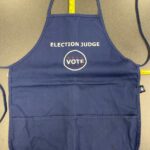 Free Election Supplies: Larimer County, Colorado, Elections just purchased some new Election Supplies. This resulted in a surplus of old supplies that are still in good condition. As they changed some of their processes, they will no longer be using these items. They are looking for anyone across the country who could use these for their
  operations. All they ask is that you arrange shipping or pick them up. Who doesn’t want a nice road trip to lovely Fort Collins, Colorado? These items include: ballot boxes (small, medium, and large), voting booths (standard and accessible), I Voted Stickers, and Election Judge Aprons (small and large). If you are interested in any of these items, please reach out to Dirk (dirk.bruley@larimer.gov) or Eric (eric.busse@larimer.gov), who can also be reached at 970-498-7820.