In Focus This Week
Vote Centers Go Mainstream
A National Look at Adoption
By: Anita Manion, David Kimball, and Jake Shaw
University of Missouri St. Louis and DePauw University
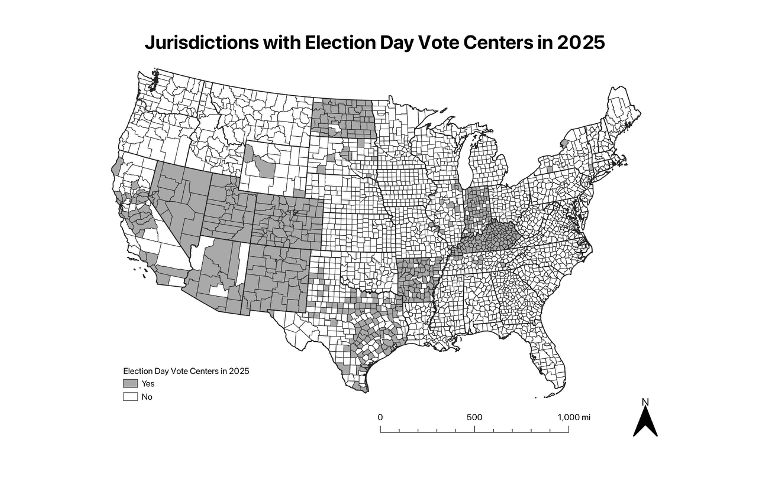
Vote centers are an alternative to assigned polling places, where jurisdictions host fewer voting locations but allow residents to vote at any location. Vote centers have expanded rapidly over the past few years. Our research team has compiled a database of jurisdictions that have adopted vote centers. We have documented at least 625 counties serving over 69 million registered voters (roughly 30% of the nation’s electorate) in 19 states that have implemented vote centers for Election Day voting. While vote centers began roughly 20 years ago, most of the adopters shifted to vote centers after the COVID pandemic in 2020. Our website and database provide critical information for researchers and practitioners, finding that tens of millions of voters cast their ballots in jurisdictions that use Election Day vote centers.
The following figure illustrates the regional patterns of Election Day vote center usage. In Western states that rely largely on vote-by-mail, vote centers are common but serve only the small share of voters who cast ballots in person. In contrast, in the Midwest and Plains states in-person voting is the norm, so a much larger share of the electorate relies on vote centers.
Key Administrative Benefits
We found a number of significant administrative benefits for jurisdictions that implemented vote centers. Since voters may cast a ballot at any location, adopting vote centers means a substantial reduction in provisional ballots (50%) and rejected provisional ballots (40%).
Adopting vote centers typically means a substantial reduction in the number of polling places (50%) and poll workers (30%), likely reducing administrative costs for local election officials. Election Administration and Voting Survey (EAVS) data also shows that vote center jurisdictions report a 9 percentage point decline in difficulty recruiting poll workers (and a similar increase in ease of recruiting poll workers) after adoption. In that same period, recruiting difficulty rose in jurisdictions without vote centers, as shown in the figure below.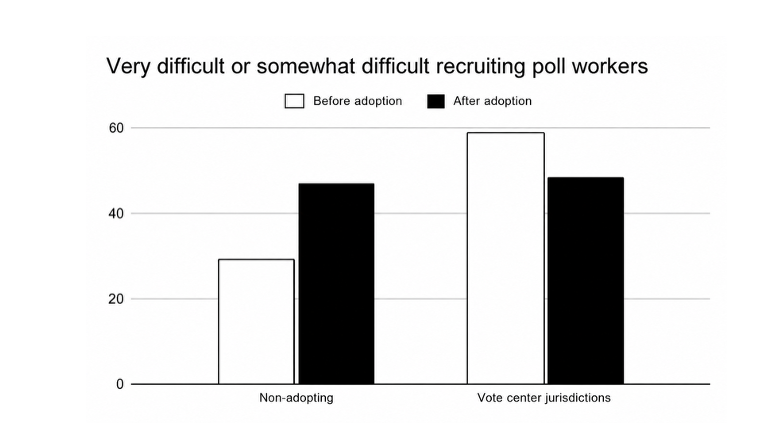
In a project with Lisa Bryant, we surveyed poll workers and registered voters in two vote center jurisdictions—Fresno County, California and St. Louis County, Missouri. We found that about 72% of voters and 93% of poll workers prefer vote centers.
Somewhat Less Positive Voting Experiences
We also examine the voting experience using data from the Survey of the Performance of American Elections (SPAE) merged with our vote center database. In the November 2024 election, Election Day vote center voters (EDVC) were less likely to say that it was very easy finding their polling place than Election Day assigned polling place voters (EDPP) and early in-person voters (EIP), as illustrated in the graph below.
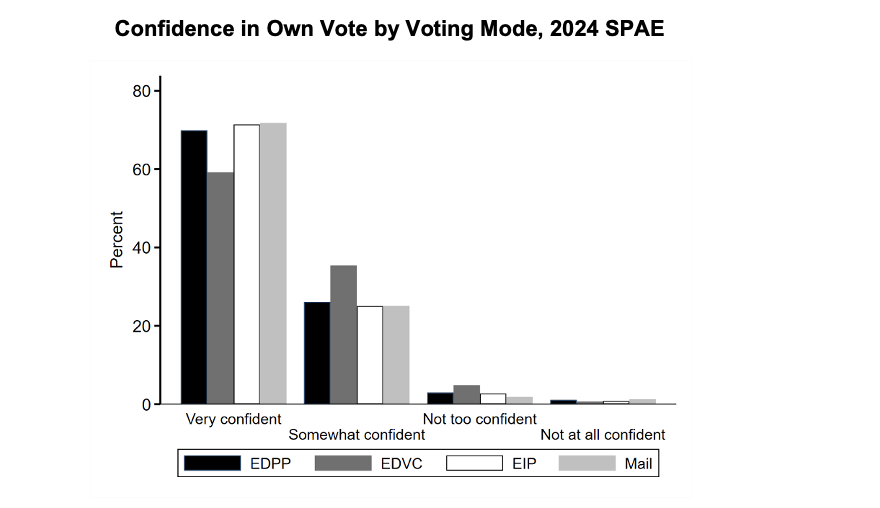
 Similarly, the figure below shows that Election Day vote center voters (EDVC) were less likely than other voters to be “very confident” that their vote was counted as they intended. In almost all the polling place and voting experience comparisons we examined with SPAE data, Election Day vote center voters were less likely than other voters to give the most positive response and more likely to give the second most positive response. Respondents who cast their ballots at an Election Day vote center still report a largely positive voting experience, but a somewhat less positive experience than other voters.
Conclusion
Vote centers have expanded rapidly and are no longer niche. Our findings suggest administrative advantages and strong support from both voters and poll workers. At the same time, vote center voters reported a somewhat less positive experience in 2024 than voters using other methods, particularly in finding their polling place. That gap suggests an opportunity for election officials to focus on voter education when adopting vote centers. Vote centers are not one-size-fits-all, and getting the benefits without the tradeoffs will depend on how the reform is implemented.
electionline Daily News Email
 What’s the best part of waking up? electionline Daily News in your inbox of course so be sure to sign up for your daily dose.
Each morning you’ll receive the top headlines of the day, plus a listing of states featured in that day’s news round up.
To sign up, simply visit our site and provide us with your email and you’ll begin receiving the news in your inbox each morning.
We Google so you don’t have to!
electionline Merch
 You’ve asked for it, well now you’ve got it! Just in time for all of your holiday gift-giving. We’ve opened up an electionline merch store using Bonfire. Currently we’re offering a couple of different t-shirts, a long-sleeve t-shirt and a hoodie.
Election News This Week
 Federal Update: Fallout from President Trump’s speech on election security continued this week with elections officials at all levels pushing back and preparing for possible federal interference in the November elections. A newly declassified report from the Cybersecurity and Infrastructure Security Agency on election security is earning bipartisan support. “It’s pretty reasonable,” said Nick Leiserson, who served in the Biden-administration White House Office of the National Cyber Director. “It’s sensible advice. So, that’s good.” The report is based on data gathered from 2019 through 2024 via voluntary security assessments conducted by CISA career staff, including static and dynamic code analysis conducted at the Idaho National Laboratory, penetration testing and incident response. The six-page report’s observations and recommendations are consistent with the guidance CISA has been giving to the election administration community for years, said Geoff Hale, a systems engineer who led the agency’s elections security efforts as a career official from 2017 to 2024. “These are professional recommendations, which in my mind do not have a political sway to them,” said Hale, currently a visiting fellow at the Center for Democracy and Technology. “There’s obviously room for improvement, but I credit CISA with doing this professionally and consistently.” U.S. Senator Raphael Warnock (D-Georgia) is calling for Congress to investigate whether states that redrew congressional districts after a recent U.S. Supreme Court decision illegally discriminated against Black voters, unveiling a broad proposal aimed at expanding voting rights nationwide.
 2026 Elections: Arizona held the only July primary this week and overall it was a smooth experience throughout The Grand Canyon Station. Secretary of State Adrian Fontes said it was a “very well run” election. A power outage reported in Maricopa County affected two voting centers on Election Day with both vote centers up and running again by 12pm. Sasha Hupka with Votebeat said that voters in Pima County were using a new mail ballot ID verification system in large numbers in the early hours of voting. Monsoon rains made Black Mesa’s dirt roads slick and impassable Tuesday, prompting Navajo County to close its vote center at Black Mesa Chapter. And State Rep. Alex Kolodin (R) will face incumbent Adrian Fontes (D) for secretary of state. In South Carolina, which is holding a “snap” Republican primary election to replace the late Sen. Lindsey Graham, the state and the U.S. Department of Justice have come to an agreement over UOCAVA voters. The agreement mandates the SEC will notify UOCAVA voters about the special election and any potential runoffs by July 24. Counties where UOCAVA voters request a ballot must send them no later than Aug. 1. Those ballot materials must be filled out and returned to election officials no later than 7 p.m. Aug. 11. Additionally, the SEC will send a report to the DOJ outlining when ballots were sent out to UOCAVA voters and when they were received. With two weeks left before the August 4 primary, nearly 600,000 Michigan voters have already cast their ballot. “Michiganders are voting by mail in tremendous numbers – demonstrating their support for this voting option,” said Deputy Secretary of State Aghogho Edevbie. “Voters know mail ballots are convenient, accessible, and that they can track their ballot to make sure it was received. As clerks throughout the state prepare to open early voting sites this Saturday, it’s clear that Michiganders are enthusiastic and engaged, which is why our state has broken turnout records in the last three statewide elections.”
 News from New Jersey: This week, New Jersey Governor Mikie Sherrill announced that about 6,600 noncitizens were registered to vote because of a software glitch in the state Motor Vehicle Commission’s automatic voter registration system, and about 400 of them cast ballots. Sherrill, who said the error began in June 2023 and was not fixed until a year later, said the state has no evidence at this time that any elections were swayed. “This entire situation is unacceptable,” Sherrill said. “It’s unacceptable that the vendor released software with such a glaring error. It’s unacceptable that the MVC took a year to get this issue fixed, and it’s unacceptable that no one, in the previous administration, brought this to light, demanded accountability.” Sherrill said she learned about the issue just last week, is investigating the software error, and will make the probe’s findings public. Republican state Sen. Joseph Pennacchio, R-Morris, is formally requesting the U.S. Department of Justice to immediately launch an investigation into the New Jersey Motor Vehicle Commission’s automatic voter registration system. New Jersey Republicans are zeroing in on the state’s automatic voter registration law and a statute allowing non-citizens to obtain driver’s licenses as culprits for what Sherrill has called a bureaucratic snafu. The GOP officials say both laws should either be repealed or rewritten to prevent any more instances of non-citizens being added to the state’s voter rolls. IDEMIA, a French biometrics and cryptography company that New Jersey officials said was responsible for erroneously adding thousands of noncitizens to voter rolls denied any mishandling — stating that the responsibility of voter registration lies with the state. Several states told USA TODAY they are examining whether the software program that allowed the noncitizens to register could have happened in their state. More than half of U.S. states and territories use the same vendor.
 I Scream, You Scream: Ben & Jerry’s has a new limited-batch Razz Up! flavor coming to both scoop shops and grocery stores. The new Razz Up! flavor features rich, sweet black raspberry ice cream swirled with red raspberry and loaded with crackling fudge chunk pieces. The Razz Up! pints are launching as part of Ben & Jerry’s voter engagement initiative ahead of the 2026 midterm elections. The chocolate-raspberry ice cream is named “Razz Up!” to encourage customers to rise up, use their voices, and exercise their right to vote. Additionally, the pints are designed with Ben & Jerry’s Social Mission in mind, featuring the word “Vote!” across the lid and cartoon images of individuals voting and marching. Razz Up! is a limited-batch flavor, meaning it will only be available in pints and at Scoop Shops for a limited time.
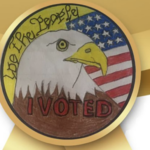 Sticker News: Jordan Mosqueda of Copperopolis Elementary School won the first Calaveras County, California “I Voted” sticker contest. Students from Edwardsburg High School and Cassopolis High School are the winners of this year’s Cass County, Michigan “I Voted” Sticker Contest, held by the Cass County
 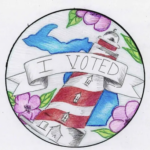 Clerk’s Office to get students engaged in the elections process. The winning students are Chloe Dennis and JaMya Hart of Cassopolis High School, and Jade Leith and Mia Neill of Edwardsburg High School. Cass County Clerk Monica McMichael says she thinks their submissions were chosen for having clear, legible, fun, and colorful designs. “They did a great job and they are looking forward to being able to vote when they’re adults. And they said this certainly piqued their interest in elections, so that was really good to hear.” “I wanted to do a drawing that represented not just Cass, but the whole state of Michigan,” Dennis said. Her design featured the state of Michigan, a lighthouse and apple blossoms, Michigan’s state flower.
 News From NASS: Washington Secretary of State Steve Hobbs has been selected President of the National Association of Secretaries of State (NASS). His term as NASS President will conclude in July 2027 at the NASS 2027 Summer Conference in New Hampshire. As a point of history, Hobbs is the fourth Washingtonian to serve in this nationally respected role. Additionally, the following members were sworn in to serve on the NASS Executive Board: President: Hon. Steve Hobbs, Washington; President-elect: Hon. Michael Howe, North Dakota; Immediate Past President: Hon. Michael Watson, Mississippi; Treasurer: Hon. Stephanie Thomas, Connecticut; Secretary: Hon. Dale Caldwell, New Jersey; Eastern Region Vice-President: Hon. Gregg Amore, Rhode Island; Southern Region Vice-President: Hon. Kris Warner, West Virginia; Midwestern Region Vice-President: Hon. Steve Simon, Minnesota; Western Region Vice-President: Hon. Phil McGrane, Idaho; Member-at-Large (NPA Section): Hon. Deidre Henderson, Utah; and Member-at-Large (ACR Section): Hon. Sarah Copeland Hanzas, Vermont. Dr. Lindsey Forson, formerly NASS Deputy Executive Director, assumed the role of NASS Executive Director, succeeding Leslie Reynolds as part of a planned leadership transition. The Office of the Connecticut Secretary of the State received the 2026 NASS IDEAS Award, which recognizes innovation and excellence in state programming, for their “Next Gen Elections: College Students Powering the Polls” initiative.
Personnel News: Robert Howden, a senior adviser to Gov. Greg Abbott, will be Texas’ interim secretary of state. Nancy Calaway is the new Ashtabula County, Ohio board of elections director. Michael Brison has been named the temporary registrar for Swampscott, Massachusetts. Greg Ballard’s name will be on the November election ballot as the Lincoln Party candidate for Indiana secretary of state. Lake County, Indiana Board of Elections and Registration Assistant Director Jessica Messler resigned from her position. Neva Helms has resigned as the Anson County, North Carolina elections director.
 In Memoriam: Joanne H. Rajoppi, the highly-regarded Union County Clerk for 30 years, a pioneer for women running for office in New Jersey, an expert on election law and county government, a noted historian, and one of the most popular vote-getters in county history, died today after an illness. She was 78. Senate President Nicholas Scutari praised Rajoppi as “one of the finest public servants in the history of the State of New Jersey.” “Her track record in keeping our elections transparent, safe, and secure was second to none,” said Scutari. “In her role as both a Democratic Party leader and an expert in elections, there were no voices I trusted more. She will be dearly missed, but her incredible legacy will never be forgotten.” In 1981 Rajoppi was appointed to serve as acting assistant secretary of state. In that post, Rajoppi was integrally involved in the recount of the closest gubernatorial election in New Jersey history. Rajoppi first ran for county clerk in 1995. She won relatively easy re-elections in 2000, 2005, 2010, 2015, and 2025. She was the first and only woman county clerk in Union County history. Her death will trigger a special election for county clerk this fall. Union County Manager Ed Oatman said Rajoppi was “an important part of our County family. ” “She remained deeply involved in the work of her office and brought decades of experience and an extraordinary sense of responsibility to her role. Her loss will be felt immediately throughout County government,” he said. “We will miss her leadership, her strength, and the unmistakable presence she brought to everything she did.”
New Research & Resources
Communication Guides: The Democracy Communications Collaborative (DCC) is sharing their latest series of nonpartisan comms guides, this one focused exclusively on the upcoming election season. Consider it “Version 1” – it will be updated frequently over the next few months with new info, new topics, and in response to requests and/or news. In addition to general guidance, you’ll see four different versions broken out by audience wedges from our Democracy Audience Map. Deeper descriptions of each audience wedge are available in corresponding tabs. The guidance is based on a combination of the DCC’s Baseline Research Program findings, the Democracy Audience Map research, and research and resources from DCC Partner organizations across the space.
Ballot Measures, Legislation & Rulemaking
 Federal Legislation: The House passed a bill to implement voter identification requirements before the midterm elections, attaching it to unrelated legislation that would also limit the ability of members of Congress to trade stocks. The Voter ID Act, which was included inside the Stop Insider Trading Act, faces a likely doomed future in the Senate, where it would need 60 votes to pass. Still, the House approved it largely along party lines on July 22, with a 232-198 vote. Republicans are already accusing Democrats of voting against what they called common-sense provisions that Americans support. Thirteen Democrats voted for the bill. Most Democrats, meanwhile, opposed it, with critics such as Rep. Joe Morelle, D-New York, arguing Republicans conjured a legislative “trick” that would “eviscerate” mail-in voting.
The House Intelligence Committee approved fiscal 2027 intelligence authorization legislation this week that also includes provisions on election security and that are meant to boost intelligence community (IC) usage of artificial intelligence for cyber and other purposes. An amendment from the panel’s top Democrat, Rep. Jim Himes of Connecticut, would require the intelligence community to publish an unclassified assessment of foreign intelligence threats to the 2026 midterms. Rep. Jason Crow of Colorado’s amendment would partially withhold funding for the ODNI until Congress gets overdue reports it had required on the 2024 and 2026 elections. And Rep. Chrissy Houlahan of Pennsylvania’s amendment would “protect analysts from retribution by IC leadership for working on intelligence products related to foreign influence in US elections,” according to a news release.
 California Ballot Measure: Voters are being asked whether they want to change the rules for recalling California state leaders. Proposition 5 would limit recall ballots to just one yes-or-no question: Should an elected official be recalled from office? Currently, recall ballots also have a second section where voters are asked to choose a successor if the recall passes. Prop 5 would eliminate that second section. If the recall passes, a new leader is chosen later in a separate process. Under Prop 5, recalls are treated as a standard vacancy with succession rules spelled out in the State Constitution. If a Governor is ousted, depending on the timing, either the lieutenant governor takes over for the remainder of the term or there’s a special election. For the other statewide offices, the governor appoints a successor until the next regularly scheduled election. Recalled members of the state legislature are replaced in special elections. Former State Senator Josh Newman wrote Prop 5, arguing that while the recall tool was originally intended to allow voters to remove unfit or corrupt officials, it’s become a political weapon to try to seize power. “The presence of that second question in today’s politics creates a set of incentives that makes it more likely that we’ll have recalls that have nothing to do with integrity, and more to do with politics,” he explained. Constitutional law experts, including the Dean of the University of California, Berkeley School of Law, Erwin Chemerinsky, have argued California’s recall process violates the principle of “one person, one vote”, where every voter has equal influence. They say the current recall process is flawed because the first section, the yes-or-no question that decides the recall, is a majority vote. However, in the second section, if the recall passes the candidate with the most votes wins. They don’t need a majority. The target of a recall can receive more votes than any other candidate on the ballot, but still be removed from office.
Backers of a ballot initiative that would change California’s voter ID rules are accusing Attorney General Rob Bonta of “rigging” the election after the attorney general’s office changed the measure’s title. Californians will vote this November on Proposition 39, which would require people to prove their citizenship when registering to vote. It would also require voters to bring an ID to the polls when voting or to provide the last four digits of a government ID — like a Social Security number — when submitting mail ballots. When supporters began gathering signatures last year, Bonta’s office issued an initial title and summary for the initiative, language that said it “establishes additional voter identification and citizenship verification requirements.” This month, just a few months before the elections, that language was updated and now says it “prohibits citizens from voting unless they present government-issued identification.” Asm. Carl DeMaio, R-San Diego, called the the change a “blatant attempt to rig the November election” by changing the title to one he called “biased” and “dishonest.” Bonta’s office defended the decision, noting that the office is required to issue a title and summary after a measure qualifies for the ballot and citing a section of the state elections code that says the language “may differ from the legislative, circulating, or other title and summary of the measure.”
Colorado Ballot Measure: In Colorado, signatures were submitted to the secretary of state’s office on July 16 for a ballot initiative related to voter identification requirements for mail-in voting. The initiative — known as Initiative 362 — would add a new section to Article VII of the Colorado Constitution to require voters to provide both their signature and an identification number, such as: the last four digits of their Social Security number; a Colorado REAL ID number; a Colorado REAL ID driver’s license number; or the last four digits of another Colorado identification number meeting federal REAL ID requirements. Additionally, Initiative 362 would require election officials to compare the information submitted by voters to the statewide voter registration database, and if there is any discrepancy in the information: the voter must be notified; the voter may correct the discrepancy by providing a copy of their identification; and the ballot cannot be counted until the discrepancy is corrected. As of 2026, Colorado requires voters to sign their mail ballot envelope, but does not require additional identification. Initiative 362 was filed on April 3 as an initiated constitutional amendment. The secretary of state’s office has until September 2 to review the signatures to determine if the petition contains at least 124,238 valid signatures, thereby meeting the minimum requirement to be placed on the ballot for November 3.
 Michigan: State Senator Jonathan Lindsey (R-Coldwater) introduced Senate Bill 1054 to roll back the state’s universal, no-questions-asked absentee voting policy and reinstate excuse-required restrictions. Under the proposed legislation, the standard allowing any registered voter to request a mail-in ballot would be replaced by specific qualifying categories. Eligible reasons to vote absentee would be restricted to physical disability, religious obligations, active duty in the military, working as an election inspector, or being 60 years of age or older. The bill has been officially referred to the Senate Committee on Elections and Ethics for further legislative consideration. Lindsey defended the measure as a “commonsense reform” aimed at improving election security and rebuilding voter confidence. He argued that universal mail-in voting invites errors and potential fraud, while asserting that Michigan’s newly implemented nine days of early in-person voting greatly minimizes the general need for absentee ballots. The proposal comes amid record-high turnout for mail-in voting in the state, with the Michigan Secretary of State’s office reporting that nearly two million voters requested absentee ballots ahead of the upcoming primary.
 Michigan Ballot Measure: The Oakland County Board of Commissioners voted 11-6 to oppose the Americans for Citizen Voting ballot initiative, a proposal to enact strict voter ID rules in Michigan. The initiative has been criticized by opponents as voter suppression, who argue that the actual impact would prevent a significant number of U.S. citizens — such as those who do not have passports — from casting their ballots. Last week’s vote makes Oakland County the fifth county in the state to formally oppose the proposal, joining the boards of commissioners of Washtenaw County, Wayne County, Ingham County and Kalamazoo County. An additional nine city or township councils have also formally opposed the proposal. The proposal would establish new voter roll verifications, compelling the secretary of state to regularly review voter rolls and remove noncitizens if they are found. It would also establish a new requirement for voters to possess a photo ID before casting a vote. Michigan election law already requires voters to show a photo driver’s license or a photo state identification card at their election precinct, or in the absence of one, sign a legal affidavit. The same is true for obtaining an absentee ballot.
Lincoln, Nebraska Ballot Measure: he “Good Government Lincoln” group on July 20 submitted signatures to the Lincoln city clerk’s office. Once the Lancaster County Election Commission verifies the signatures collected, the three proposed amendments to the city charter will be added to the November ballot. The petitions for new amendments all deal with restructuring Lincoln’s elections. The group, led by former state tax commissioner and state Sen. Tony Fulton, is hoping to expand voting to certain residents outside of Lincoln for certain elections. Those targeted residents live in Lincoln’s “extraterritorial zoning jurisdiction,” which is the three-mile area surrounding the city. The group is also seeking two four-year term limits for Lincoln City Council members and to realign the timing of city elections with statewide elections. That alignment of elections would begin in 2028. To have the necessary amount of signatures, a charter amendment petition requires 5% of registered voters in the previous governor’s race – roughly 5,000.
North Carolina Rulemaking: The North Carolina State Board of Elections approved on July 20 a measure to disqualify certain absentee ballots ahead of the 2026 midterms. Members voted 3-2 along party lines. The measure allows county elections board staff to take further action on ballots with “irregularities.” Examples include not properly sealing a ballot or using the wrong type of envelope. Staff should contact voters, but without appropriate action, the ballots may be tossed. Republicans say the change would enhance election security. Democratic critics say it would disenfranchise legitimate voters, and could be applied arbitrarily with political motives. North Carolina’s Rules Review Commission, made up of Republican appointees, needs to approve the change before it takes effect. Last week, the elections board voted in favor of a rule to make it easier to throw out voters’ ballots if they don’t show photo identification. Under the measure, an elections board could toss a ballot by majority vote if they think a voter is lying about their lack of photo ID. Current rules require bipartisan agreement. “I think it’s confusing,” Democratic board member Siobhan Millen said. “We’re going to lose perfectly sound ballots due to over-fussiness.” “I don’t think it’s fussy. I don’t think it’s picky. I don’t think it’s hard,” responded Republican board member Angela Hawkins. Hawkins says voters confused by the container return envelope used in absentee voting may contact their local elections board for clarification.
Legal Updates
 Federal Litigation: The D.C. Circuit Court of Appeals handed the Trump administration a temporary win on July 17 in its attempt to increase federal oversight of elections. In a unanimous ruling, a three-judge panel of the D.C. Circuit Court of Appeals put on hold a lower court ruling, which had blocked the U.S. Postal Service from attempting to restrict mail-in voting. However, the Trump administration does not yet have a green light to move forward with the proposed rule. A separate judge in Massachusetts blocked the policy last month, and that injunction still stands. The cases center on a proposed rule from the U.S. Postal Service that sought to compel states to create lists of approved voters, as well as impose stricter regulations on mail-in ballots. The NAACP, which brought the lawsuit, had previously sued the Postal Service in 2020, seeking to challenge delays in delivering mail-in ballots heading into that year’s presidential election. The two sides settled in 2021, with the Postal Service agreeing to “prioritiz[e] . . . the timely delivery of Election Mail” for every national election through 2028. In the ruling, the appeals court said the Trump administration is likely to succeed because the lawsuit is premature — since the rule itself is not yet finalized — and not covered by a 2021 settlement between the NAACP and Postal Service. The appeals court also said the Trump administration demonstrated they would be irreparably harmed if the Postal Service can’t finalize and implement the rule in time for the midterms. “In this context, ‘there can be no do over’ once the election occurs,” the ruling said. While the Trump administration cannot yet move forward with the new rule, the D.C. Circuit’s ruling signals that the Trump administration may be able convince other appeals courts to let them implement the policy while the lawsuits move through the courts — potentially past the November elections.
 Arizona: Neil DeSanti, a perennial Republican candidate, was indicted earlier this month for falsely registering to vote and illegally voting, both felonies, because he never had his right to vote restored after pleading guilty to multiple felonies in 2010. DeSanti currently serves as a Republican precinct committeeman in his north Phoenix legislative district, a post that is restricted to legally registered voters. Although Maricopa County Superior Court Commissioner Christina Henderson restored DeSanti’s rights in relation to a 2004 drunk driving case, in which he pleaded guilty to felony endangerment, she denied his identical request in a case where DeSanti pleaded guilty to felony possession of burglary tools after he and his cousin were caught stealing a metal ramp from a commercial yard near downtown Phoenix. The Maricopa County Attorney’s Office urged the court to deny DeSanti’s request to have his rights restored. Henderson wrote that she denied the petition because that crime had a victim and occurred while he was on release in the drunk driving case. A grand jury empaneled by the Arizona Attorney General’s Office indicted DeSanti on four felony counts of false voter registration — one for the first time he registered in 2012 and three for registration updates in 2018, 2020 and 2021 — and two felony counts of illegal voting, related to the ballots he cast in November 2024 and November 2025. The indictment was handed down on July 13.
 Connecticut: U.S. District Court Judge Kari A. Dooley upheld the refusal of Connecticut officials to provide voter information that the Trump administration demanded from the state. Dooley dismissed a U.S. Department of Justice lawsuit that sought to compel Connecticut to turn over its complete, unredacted statewide voter registration list. The adverse ruling represented another legal setback in the Trump administration’s quest for detailed information from states about the nation’s voters. “This lawsuit was an illegal attempt to disenfranchise Connecticut voters and today, the court shut it down. The Constitution is clear: the President does not control our elections and has no right to manipulate Connecticut voter rolls. Connecticut follows federal law and takes its obligations under federal law very seriously. We will not be bullied into handing over sensitive voter information just because Trump demands it,” Attorney General Tong said in a statement. Dooley concluded in a 12-page ruling that Secretary of the State Stephanie Thomas does not have to comply with the federal government’s demand because the demanded voter records are not covered under the section of the Civil Rights Act of 1960 that the Trump administration invoked.
 Florida: John Panicci, a Palm Beach County man accused of taking an encrypted USB key from the supervisor of elections office appeared in court July 17 for a plea deal hearing, but the case did not result in a resolution. Panicci is accused of taking an encrypted USB access key from a voter registration training terminal at the Palm Beach County supervisor of elections office in March. Election officials said the USB key was used to access a training database that contained only fake names, addresses and voter ID numbers, with no real voter information. Panicci is charged with unlawful use of an electronic device following an investigation into the alleged theft. Panicci is accused of taking an encrypted USB access key from a voter registration training terminal at the Palm Beach County supervisor of elections office in March. Election officials said the USB key was used to access a training database that contained only fake names, addresses and voter ID numbers, with no real voter information. Panicci is charged with unlawful use of an electronic device following an investigation into the alleged theft. During the hearing attorneys for both the prosecution and defense approached the bench for a private, off-the-record discussion with the judge. After the off-the-record bench conference, the judge rejected the plea and the case was set for depositions and a status hearing. The judge scheduled a status check for Aug. 28, and the case remains active.
Opinions This Week
National Opinions: President’s speech, II, III, IV, V, VI, VII, VIII, IX | Election fraud | SAVE Act | Noncitizens | Voter data | U.S. Supreme Court | Voting system | Election administration, II, III | Faith in elections |
Alaska: Ranked choice voting | Vote by mail |
Arizona: Maricopa County |
Connecticut: Election fraud |
Florida: Redistricting | Vote by mail | Local election officials | The Big Lie | Vote by mail |
Hawai’i: Federal interference |
Iowa: Turnout |
Nevada: Department of Homeland Security |
New Jersey: Voter fraud myth | Noncitizens |
New York: Ranked choice voting |
North Carolina: Rulemaking | Noncitizens | Election integrity |
Ohio: Voting rights | Ranked choice voting | Election security |
Oregon: Election security, II |
Washington: Election threats |
Upcoming Events
iGO 9th Annual Conference: The International Association of Government Officials will hold its 9th Annual Conference from July 25-28 in Reston, Virginia. When: July 25-28. Where: Reston, Virginia.
2026 NCSL Legislative Summit: The 2026 NCSL Legislative Summit takes place in Chicago July 27-29, bringing together state legislators and legislative staff from all 50 states and U.S. territories for three days of collaboration, innovation and bipartisan dialogue. When: July 27-29. Where: Chicago.
SCARE 2026 Annual Conference: The South Carolina Association of Registration and Election Officials (SCARE) will hold its annual conference from July 27-30 in Isle of Palms.
Elections à la Carte: The Journal of Election Administration Research & Practice invites you to join us over Zoom for another lunchtime conversation on innovative funding solutions for election administration. This edition of Elections à la Carte will focus on strategies for reducing election costs as well as nontraditional funding source possibilities. Our panel will include: Zach Mohr – professor at the University of Kansas – who will discuss the potential of taxing political advertising to fund election administration; Lucca Carlson – an elections data analyst – who proposes utilizing college students as poll workers as a way for the students to satisfy costs related to any state-funded financial aid they receive, and Jenny Hillary and Nick Fisch – experienced local election officials from Dubuque County, Iowa – who advocate for adding a small convenience fee to driver’s license/non-operator identification issuances and renewals to fund election administration. Our panel will offer a brief explanation of their ideas, which will be followed by an in-depth discussion on avenues for moving these ideas into the real world. Before the webinar, attendees are encouraged to submit questions they would like the panel to discuss to Brandon Fincher at finchrb@auburn.edu. The panel will try to address as many questions as time permits. When: July 29, 12pm Eastern. Where: Online.
Plan First, Panic Never: Election Day Disruptions: Evacuations and breakdowns and rumors, oh my! You don’t know what it is yet, but you do know there’s always something on Election Day. Whether it’s clearing out a building, equipment that goes on break before you do, or gossip that moves faster than facts, election offices must do the work now to limit the impact of future disruptions. Join the Election Security Exchange for a practical conversation and Q&A with current and former election administrators who have encountered the above scenarios (and then some). Instead of improvising in the moment, learn how to plan for disruptions and execute the basics ahead of time, so you can stay steady when it counts and know exactly what to do next. We’ll cover how to: Understand and connect with real-world events; Name who makes the call and who gets notified first; Maintain and secure operations throughout disruptions; and Communicate in plain language from one trusted voice to another Featured Panelists: Tonya Wichman, Director, Defiance County Board of Elections, Ohio; Ben Spear, Chief Infrastructure & Security Officer, New York State Board of Elections; and Matthew Tlachac, State and Local Director, Ready for Tuesday. When: July 29, 3pm Eastern. Where: Online.
Louisiana v. Callais: How We Got Here, What It Means, and Where We Go Next: On April 29, 2026, the U.S. Supreme Court handed down its decision in Louisiana v. Callais, holding that Louisiana’s decision to add a majority-minority district was an unconstitutional racial gerrymander. But the opinion’s “antiseptic” reasoning and holding, in the words of Justice Kagan, belie a larger reality: Callais is the last of three decisions through which the Roberts Court has, in less than 15 years, effectively eviscerated one of our nation’s most consequential laws—the Voting Rights Act of 1965. As Justice Kagan explained in her dissent, that law was “born of the literal blood of Union soldiers and civil rights marchers,” and brought the country “closer to fulfilling the ideals of democracy and racial equality.” And yet the Supreme Court has now overridden Congress’s considered and consistently reiterated view that the law was a necessary corrective to decades of attempts by States to disenfranchise minority populations. Please join the Washington DC and New York ACS Lawyer Chapters for a timely discussion of this decision by voting rights experts. Come learn about the origins of the law; what Callais and other decisions have done for it; what Callais means; what comes next; and, most importantly, what you can do to respond. Please RSVP by Friday, July 31. When: August 3, 12:30pm Eastern. Where: Online
Oregon Association of County Clerks: The Oregon Association of County Clerks will hold its annual conference from August 10-13 in Burns.
National Poll Worker Recruitment Day: National Poll Worker Recruitment Day and Help America Vote Day were established by the U.S. Election Assistance Commission (EAC) to inspire civic engagement and encourage people to sign up to become a poll worker. The EAC will recognize August 11, 2026, as National Poll Worker Recruitment Day. These efforts aim to address the continued need for poll workers to sign up to Help America Vote and strengthen our democracy. When: August 11.
WMCA 46th Annual Conference 2026: The Wisconsin Municipal Clerks Association will hold its annual conference from August 18-21 in Green Bay.
Election Center 41st Annual Conference: The National Association of Election Officials (Election Center) will hold its 41st Annual Conference in Kansas City, Missouri from August 19 to 21. CERA classes will be offered August 22 and 23. When: August 19 to 21. Where: Kansas City, Missouri.
UAC Annual Convention: The Utah Association of Counties will hold its annual convention from September 8-10.
National Voter Registration Day: First observed in 2012, over 5 million voters have registered to vote on National Voter Registration Day to date. As many as 1 in 5 eligible Americans are not registered to vote. Help us change that by joining the country’s largest single-day voter registration drive and organizing a registration event in your community! When: September 15.
2026 WACO Conference: The Wyoming Association of County Officers-County Clerks will hold its annual conference from September 22-24 in Laramie.
2026 MACO Annual Conference: The Montana Association of Counties will hold its annual conference from September 27-30 in Helena.
National Voter Education Week: Voters should have the information they need to cast their ballots with confidence. That’s where National Voter Education Week comes in. Help voters find their polling location, understand their ballot, and make a plan to vote by joining our week-long campaign. When: October 5-9.
Election Hero Day: Election Hero Day is a nonpartisan, national celebration recognizing the tremendous contributions that election officials, their staff, and poll workers make to ensure a safe, secure voting experience for all Americans. Taking place on October 20, 2026, nonprofits, business leaders, brands, public officials, and more will unite to honor the election heroes in our communities. With your support, Election Hero Day will help boost election official morale ahead of Election Day and send a clear message to the public that we support our friends and neighbors who play such a vital role in preserving our democracy. When: October 20.
Vote Early Day: When Americans vote early, they ensure last-minute problems, long lines at the polls, confusing election laws, or voter disinformation cannot prevent us from casting our ballot. Vote Early Day is a tentpole moment for partners nationwide to engage with voters and empower them with the tools to cast their ballots early. When: October 27.
Job Postings This Week
electionlineWeekly publishes election administration job postings each week as a free service to our readers. To have your job listed in the newsletter, please send a copy of the job description, including a web link to mmoretti@electionline.org. Job postings must be received by 5pm on Wednesday in order to appear in the Thursday newsletter. Listings will run for three weeks or till the deadline listed in the posting.
Account Executive, VotingWorks– We are looking for a trusted sales leader who understands that election administrators don’t buy voting machines, they buy trust, both in the equipment and in the vendor. All 83 of Michigan’s counties will soon open at once, and we are in the running for the state RFP enabling us to sell our voting machines. Incumbents will have to re-earn their contracts, and we’ll be competing on equal footing for the first time. This opportunity is time bound. Trust matters deeply in this market. Your job is to build relationships and earn credibility quickly with state and local election officials. You will own the full Michigan territory. You’re responsible for the entire sales process: building pipeline, running demos, navigating procurement, and closing deals. We want sustainable sales contracts that are technically sound, politically supported, and set up for a clean handoff to Customer Success. For your first demos, you’ll be paired with our Executive Director and our Head of Customer Success to learn the messaging and the product. Once you take on demos on your own, you should still know when to bring in executive support and when to handle things yourself. This is a competitive market with a real window of opportunity. If you want to sell something that actually matters to Democracy, and you’re energized by moving fast when the timing is right, we’d like to meet you. Application: For the complete job listing and to apply, click here.
Accounts Payable & Payroll Specialist, King County, Washington– This is an amazing opportunity to be engaged in the election process! The Department of Elections is searching for energetic and resourceful professionals who like to “get stuff done”. The Accounts Payable & Payroll Specialist position in the Elections Department combines an exciting, fast paced environment with the opportunity to cultivate talents and apply a variety of skills. The ideal candidate will thrive in an innovative and fast-paced environment and will not hesitate to roll up both sleeves, work hard, have fun, and get the job done. We are seeking a detail-oriented and collaborative professional to support payroll, finance, and human resources operations. The Accounts Payable & Payroll Specialist supports the department’s mission by processing vendor payments and payroll, maintaining accurate financial and employee records, supporting audits and reporting, and contributing to continuous improvement initiatives. Work is performed under limited supervision and requires independent judgment. This position reports directly to the Administrative Services Manager and works closely with both the Finance Administrator I and the Human Resource Analyst. The ideal candidate thrives in a fast-paced environment, values accuracy and confidentiality, and enjoys delivering exceptional customer service to employees and partners throughout the organization. Salary: $32.44 – $41.25 Hourly. Application: For the complete job listing and to apply, click here.
Administrative Specialist (Elections Specialist–Russian), King County, Washington– This is an amazing opportunity to be engaged in the election process! The Department of Elections is searching for energetic and resourceful professionals who like to “get stuff done”. The Administrative Specialist II positions in the Voter Services Department combines an exciting, fast-paced environment with the opportunity to cultivate talents and apply a variety of skills. The ideal candidate will have a desire to help ensure the democratic process through public service. They will thrive in an innovative environment and will not hesitate to roll up both sleeves, work hard, have fun, and get the job done. King County Elections (KCE) manages voter registrations and elections for more than 1.4 million voters in King County, one of the largest vote-by-mail counties in the United States. KCE’s mission is to conduct accessible, secure, and accurate elections. As a leader in providing inclusive elections, KCE is focused on core values of accuracy, equity, integrity, service, teamwork, and transparency. The team at KCE is committed to ensuring all King County voters can get registered, cast their ballot, and make their voices heard. Salary: $29.46 – $37.47 Hourly. Application: For the complete job listing and to apply, click here.
Customer Support Center Consultant Level 1, Hart InterCivic– The Customer Support Center Consultant Level 1 (CSC 1) provides Tier 1–2 support for Hart InterCivic products, helping customers troubleshoot issues and keep election operations running smoothly. The CSC I’s primary responsibilities are to: Resolve and route customer issues via phone, email, and remote tools; Document cases in the CRM and communicate status through resolution; and Use product documentation to deliver clear, customer-friendly solutions. This role researches and resolves issues, supports hardware/software configuration and deployment, and provides training or on-site support as needed. It also documents processes and partners with other departments to improve service delivery. This position follows the Proprietary Information and Intellectual Property Agreement and is responsible for protecting company information, including when working off-site or outside normal hours. Application: For the complete job listing and to apply, click here.
Cybersecurity Assessor (Election Security), Apollo Information Systems: The Technical Assessor conducts in-depth technical and program-level cybersecurity assessments of client environments, identifying risk, measuring control maturity, and producing clear, actionable guidance that advances each client’s security posture. This is an experienced assessor role: the individual independently leads assessments end to end, evaluates complex environments against multiple frameworks, and is a trusted voice in front of both technical teams and executives. The assessor also helps mature Apollo’s assessment method. Salary: $80K – $120K. Application: For the complete job listing and to apply, click here.
Deputy Director, New Hanover County, North Carolina– Are you an experienced elections or public administration professional with a strong commitment to public service? New Hanover County is seeking an Elections Deputy Director to support the Elections Director in overseeing daily operations and ensuring the successful delivery of election services. This role provides staff supervision and assists with procedural and technical improvements, voter education programs, public communications, in-person voting operations, Board of Elections meeting preparation, and election official training. The Deputy Director ensures continuity of operations in the Director’s absence and directly supervises teams responsible for voter registration, outreach, and logistics, maintaining a high level of customer service during large-scale election events and periods of increased demand. Salary: $62,126.00 to $83,870.50. Application: For the complete job listing and to apply, click here.
Deputy Elections Administrator, Tarrant County, Texas – The Deputy Elections Administrator is responsible for assisting with and overseeing the daily operations of the Elections Administration Department, including coordination of Voter Registrar duties and all election management activities for Tarrant County. This position provides executive-level operational and tactical leadership and exercises full authority in the absence of the Elections Administrator. Responsibilities include managing personnel, directing election logistics, ensuring legal compliance, overseeing technology and equipment deployment, coordinating poll worker operations, and maintaining the integrity and security of all election processes. Application: For the complete job listing and to apply, click here.
Director of Technology and Security Initiatives, National Association of Secretaries of State– Role Includes: Lead NASS Technology & Security Initiatives; Lead NASS Tech Talk Group for IT Leaders in Secretary of State Offices; Federal and Stakeholder Affairs; Member Office Assistance; and NASS Internal Technology and Security Assistance This position is hybrid – working from home and the NASS DC office with about 1-3 weeks of travel per year. Fully remote applicants may be considered. Salary: $90,000-$110,000. Application: For the complete job listing and to apply, click here.
GIS Specialist, Palm Beach County, Florida– Help power accurate, well-run elections through smart mapping and rock-solid data. As a GIS Specialist II with the Palm Beach County Supervisor of Elections, you’ll own core geospatial datasets, turn complex information into clear maps and insights, and improve the workflows teams rely on to plan and execute election operations. Your work helps ensure precinct, polling place, and district data is accurate and easy to use—supporting operational readiness, transparency, and timely decision-making. You’ll maintain and enhance GIS databases, produce print and web-ready map products, perform quality control and spatial analysis, and keep GIS synchronized with the Voter Registration System. You’ll collaborate with both technical and non-technical teams, document standards and changes, and provide training and troubleshooting support. Salary: $72,800 to $87,000. Application: For the complete job listing and to apply, click here.
IT Assistant Manager, Palm Beach County, Florida–The Assistant IT Manager plays a vital and supportive role in ensuring the smooth operation of the IT department, aligning both the technical infrastructure and the team with the organization’s goals. This position involves collaborating closely with the Election Technology Director to oversee the implementation of technology solutions that meet the organization’s needs. The Assistant IT Manager helps maintain an efficient and effective IT environment. The Palm Beach County Supervisor of Elections Office is committed to hiring talented individuals with diverse experiences that will enhance the services we provide to the residents of Palm Beach County. We are always looking for dedicated individuals who do all things with Integrity and Accountability, who excel in Customer Service, and believe in Transparent, Secure Democracy. At the Supervisor of Elections Office, we strive to help our employees find passion and purpose. Join us in being the best place to vote. Salary: $85000 to $125000. Application: For the complete job listing and to apply, click here.
Registration Specialist/Senior Registration Specialist, Arapahoe County, Colorado – The Registration Specialist is an entry level position responsible for supporting the daily operations of the Voter Services Team in the Arapahoe County Clerk and Recorder’s Office. This position is responsible for providing excellent customer service while assisting with voter registration processing and upkeep of database integrity. The Registration Specialist must be able to complete assignments of basic scope or complexity with limited assistance. Salary: $19.62 – $35.61. Deadline: August 10. Application: For the complete job listing and to apply, click here.
Senior Elections Specialist (Logistics), New Hanover County, North Carolina– New Hanover County is seeking a Senior Elections Specialist (Logistics). This role is responsible for executing key aspects of the elections administration process, including voting site management, supply management and distribution, and for managing multiple large projects. The mission of the New Hanover County Board of Elections is to provide the highest level of professional standards to ensure accurate, honest, and fair elections through accountability and integrity and to provide all citizens our services in the most efficient, effective, and timely manner. Serving under the authority of the five-member Board of Elections, this office is responsible for the administration of elections. Responsibilities of the office staff include canvassing of returns, certification of abstracts and certificates for elected offices, administrating candidate filing, campaign finance, voter registration, programming, and maintenance of voting equipment among other critical tasks as appropriately delegated by the Board to the Director under N.C. General Statutes Chapter 163, or by the rules, orders, and directives of the State Board of Elections. The New Hanover County Board of Elections is a fast-paced environment comprised of a team of dedicated professionals who are committed to ensuring safe and fair elections for the citizens of New Hanover County in a non-partisan manner. It is expected that all members of the Board of Elections staff have strong technical skills, an eye for detail, a willingness to ask questions, the ability to multitask and shift priorities seamlessly, and be able to meet the physical demands of their assigned responsibilities. Salary: $46,360.00 – $78,811. Deadline: August 5. Application: For the complete job listing and to apply, click here.
Senior Policy Director & Counsel, Common Cause–We are looking for a Senior Policy Director & Counsel, Voting & Fair Representation, to lead Common Cause’s work to protect voting rights, ensure free and fair elections, and strengthen representative democracy. This leader will set the vision for our voting and fair representation policy pillar, lead our national Election Protection program, and bring together policy, litigation, legislative advocacy, organizing, and communications strategies to meet the challenges facing our democracy. The Senior Policy Director will lead a growing team of experts and work across Common Cause’s national and 22 state teams and coalition partnerships to turn ideas into action. This role requires a strategic leader who brings deep expertise in voting and fair representation, strong judgment in navigating complex political and legal landscapes, and the ability to build programmatic strategies that deliver impact. This is a full-time role reporting to the Vice President, Policy; this role is based in Washington, DC with an expectation to come into our office at least two days per week and travel at least six times per year. We hope our new Senior Policy Director and Counsel, Voting & Fair Representation will start in September. Salary: $132,613 – $148,526 a year. Application: For the complete listing and to apply, click here.
Wisconsin State Lead, Vet the Vote– We the Veterans and Military Families seeks a highly organized, mission-driven State Lead who is passionate about positive patriotism, public service, and our mission to empower the veteran and military family community to strengthen America. The ideal candidate is a strong communicator and relationship-builder who can manage multiple projects, coordinate with state partners and election officials, and support program execution with attention to detail and follow-through. This role is well-suited for someone who thrives in a fast-paced, collaborative environment and is motivated by nonpartisan, values-driven work. Candidates with experience in election administration and/or organizations supporting the veteran and military family member community are strongly encouraged to apply. Salary: $5,000/month. Application: For the complete job listing and to apply, click here.
Marketplace
electionline provides no guarantees as to the quality of the items and the accuracy of the information provided about the items in the Marketplace. Ads are provided directly by sellers and are not verified by electionline. If you have an ad for Marketplace, please email it to: mmoretti@electionline.org